

Quantum-CLI: A powerful CLI to build, run, and test Quantum Machines.

Execute Your Workflow in a Loop with QuantumDataLytica
QuantumLoop is a powerful enhancement to our no-code data automation platform.

QuantumDataLytica vs Traditional ETL Tools: Accelerate Your Data Integration Without Coding
Traditional Extract, Transform, Load (ETL) tools have long been at the core of data integration practices.
QuantumDataLytica: The No-Code Alternative to Traditional ETL
For years, ETL (Extract, Transform, Load) solutions have been the cornerstone of data integration.
How Hotel Switchboard Cut Cloud Costs by 51% and Scaled to 500+ Properties Using QuantumDataLytica
Table of Contents
Executive Summary
Hotel Switchboard is a hospitality analytics and revenue intelligence platform that supports multi-property hotel groups across the United States. As their customer base grew, so did the complexity of their data automation. They were running dozens of ingestion, transformation, rate-shopping, forecasting, and reporting pipelines on custom AWS infrastructure—an environment that became costly, difficult to scale, and increasingly fragile under higher property loads.
By late 2024, the engineering team was facing three major challenges: rising AWS compute and storage costs, operational overhead in maintaining Lambda-based pipelines, and the inability to scale smoothly without constant DevOps intervention. Every time they onboarded a new hotel, infrastructure had to be adjusted, monitored, and re-optimized. Growth became a burden instead of an opportunity.
To break this cycle, Hotel Switchboard migrated their entire data automation layer to QuantumDataLytica—leveraging its no-code orchestration engine, marketplace components, and scalable cloud execution. Within weeks, they consolidated pipelines, eliminated their AWS dependency, and replaced over 70% of manual engineering tasks with modular, automated workflows.
The impact was immediate: monthly cloud spend dropped from $5,390 to roughly $2,700, pipeline stability increased to 99.99% reliability, onboarding new properties no longer required any infrastructure work, and the data engineering team now launches new automation in minutes instead of weeks. QuantumDataLytica has become the backbone of Hotel Switchboard’s operational scalability and analytics growth.
About the Client
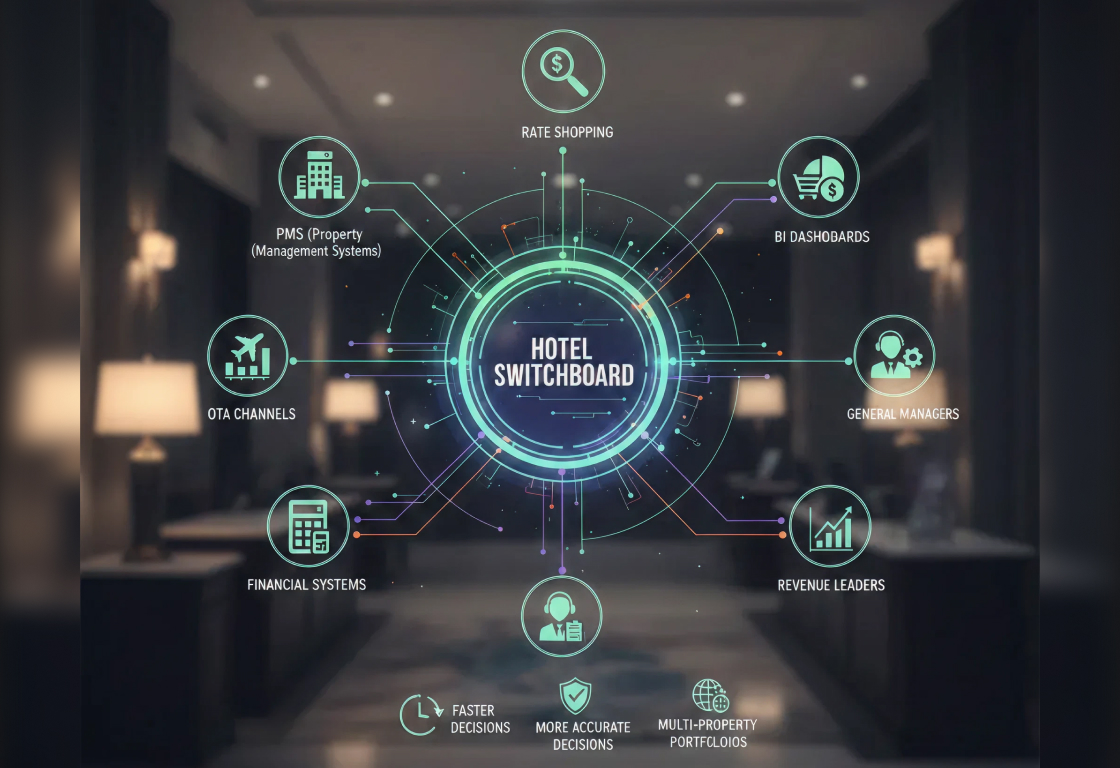
Hotel Switchboard is a unified hospitality data platform that helps hotel owners, general managers, and revenue leaders make faster, more accurate decisions. The company aggregates data from Property Management Systems (PMS), Rate Shopping tools, BI dashboards, OTA channels, and financial systems to provide a single source of truth for multi-property hotel portfolios.
Serving both independent hotels and emerging hotel groups, Hotel Switchboard operates as the central layer connecting operations, revenue, forecasting, and competitive analytics. With a growing network of properties across the United States, their platform processes thousands of daily data points—spanning occupancy insights, pricing intelligence, guest behavior, and multi-channel performance metrics.
As the platform expanded, so did the demand for more reliable, scalable, and cost-efficient automation. Their engineering team recognized the need for a smarter orchestration layer capable of supporting their long-term growth without relying on heavy cloud infrastructure or complex DevOps maintenance.
The Challenge
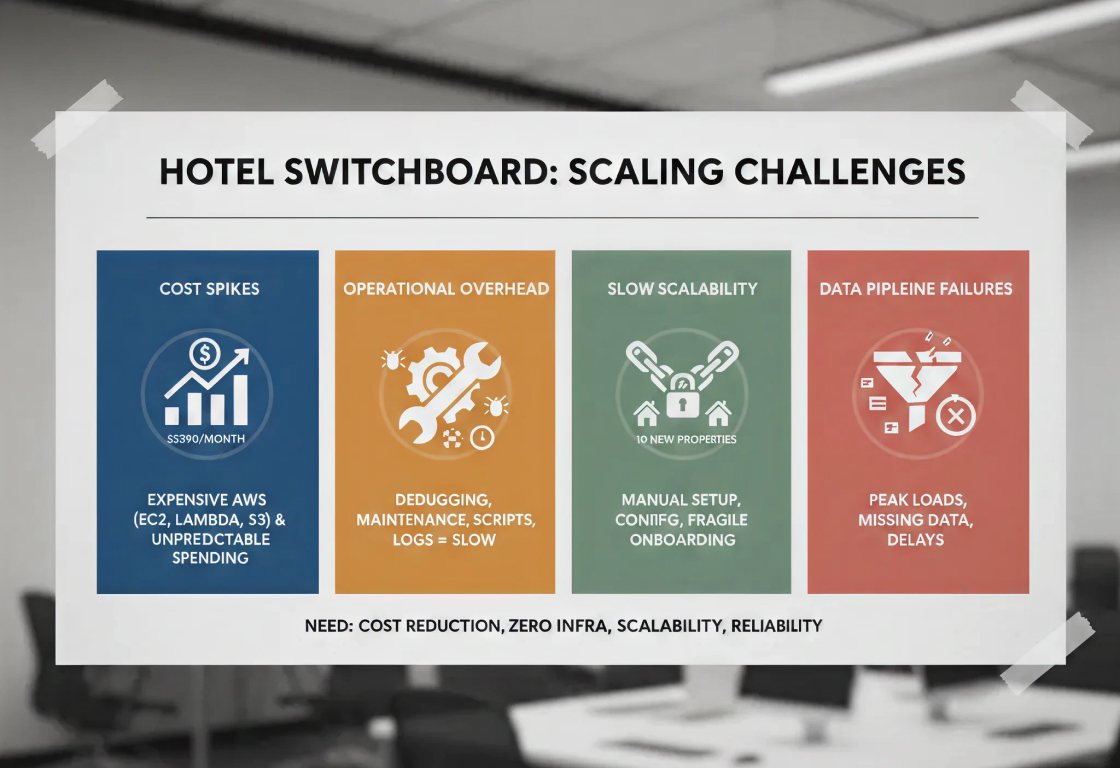
As Hotel Switchboard expanded its platform to serve more properties, the limitations of their AWS-based automation stack became impossible to ignore. Their data pipelines—spread across EC2, Lambda, S3, CloudWatch, and cron-based ETLs—were functional, but increasingly expensive to operate and difficult to maintain.
The first pressure point was cost. Monthly AWS spending had climbed to $5,390, driven by high-memory EC2 instances, unpredictable compute spikes, and the constant need for additional storage and monitoring tools. Each new property increased load, cost, and risk.
The second issue was operational overhead. The engineering team spent a growing amount of time babysitting infrastructure—debugging Lambda timeouts, optimizing runtimes, rotating keys, cleaning logs, handling API throttling, and patching scripts. Instead of building new capabilities, they were stuck maintaining the old ones.
Scaling was a third pain point. Adding 10 new properties wasn’t just a toggle—it required infrastructure tuning, concurrency adjustments, new cron schedules, memory allocation changes, and careful monitoring. This made onboarding slow, fragile, and stressful.
Finally, pipelines began to struggle under higher volume. Peak-hour rate shopping jobs and multi-property refresh cycles caused intermittent failures, missing data, delayed dashboards, and manual reprocessing. The system simply wasn’t built for the next stage of their growth.
Hotel Switchboard needed a solution that eliminated infrastructure work, reduced cost, and provided smooth, predictable scalability—without compromising reliability.
Why They Chose QuantumDataLytica
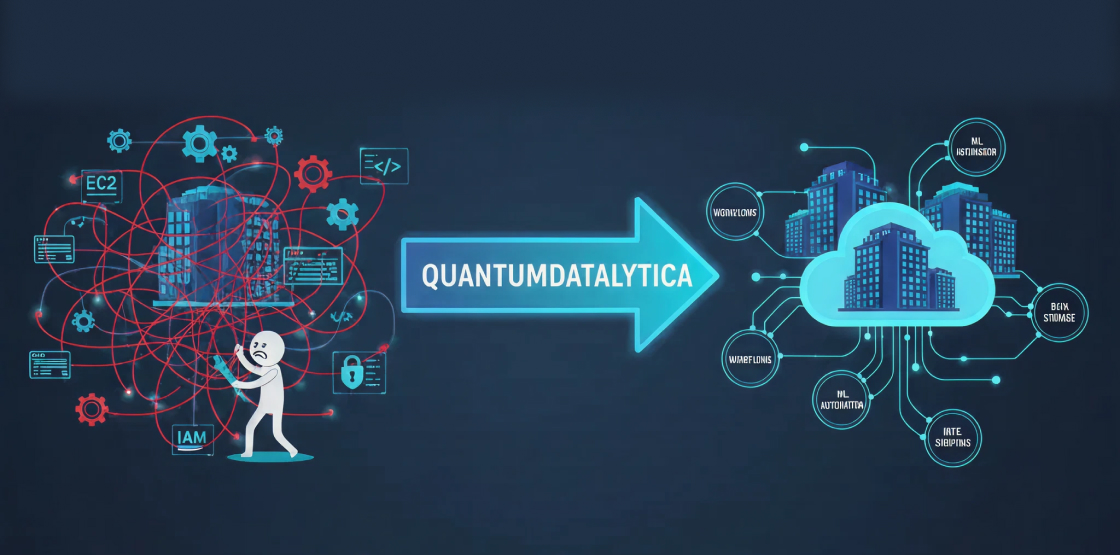
The turning point for Hotel Switchboard came when the engineering team realized that their existing architecture was slowing them down more than it was supporting them. Growth was increasing infrastructure cost, not value. Every new property meant more DevOps intervention, more monitoring, and more risk of failure. They needed a platform that could scale with them—not fight against them.
QuantumDataLytica offered a fundamentally different approach. Instead of managing compute, memory, servers, and orchestration tools, they could operate purely at the workflow level. The execution layer, scaling engine, retries, error handling, and logging were all built-in. No more configuring EC2, debugging Lambdas, or juggling IAM policies.
Cost was another decisive factor. QuantumDataLytica’s usage-based pricing was significantly lower than maintaining a multi-service AWS footprint. Early cost modeling showed an immediate 40–55% reduction in monthly spend, with no performance trade-offs.
But what finally convinced the team was capability. The platform came with ready-to-use marketplace components—ML models, rate-shopping connectors, storage integrations, AI automations—that replaced hundreds of lines of custom code. Migration meant acceleration, not downtime.
And most importantly, QuantumDataLytica solved their biggest fear: scaling. Whether they onboard 50 new properties or 500, the platform handles execution automatically, with no infrastructure choices, provisioning, or manual tuning.
The decision was logical, data-driven, and aligned with their long-term strategy: reduce cost, eliminate DevOps overhead, and build a future-ready automation engine.
The Solution
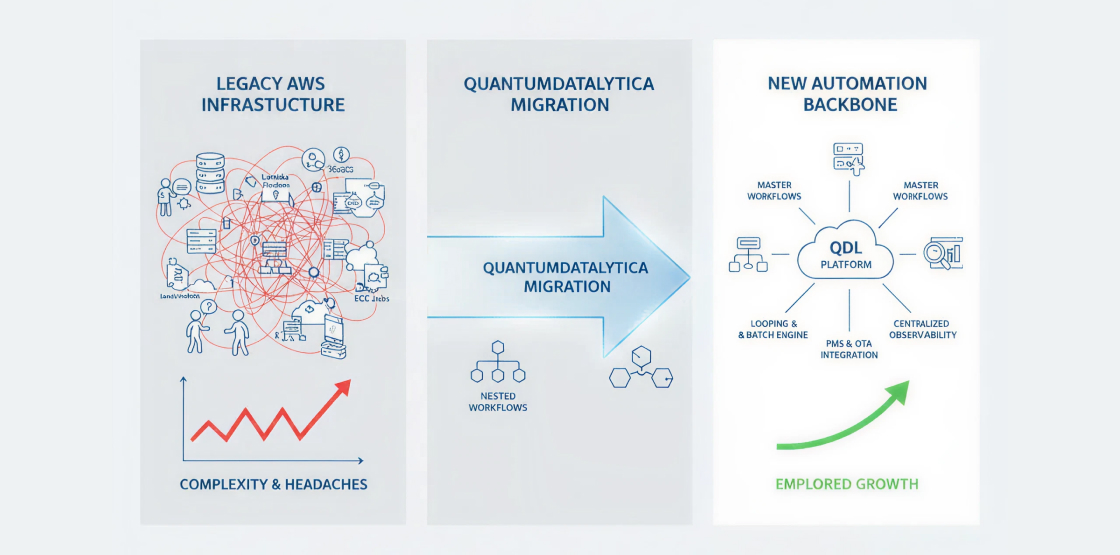
QuantumDataLytica became the new automation backbone for Hotel Switchboard, replacing their AWS infrastructure with a single, scalable, no-code orchestration layer. The migration was executed in phases to ensure reliability, accuracy, and zero downtime for active hotel operations.
6.1 Migration Approach
The first step was to map every existing AWS pipeline—Lambda functions, scheduled ETLs, EC2 processing jobs, S3 storage routines, and custom Python scripts—into modular QuantumDataLytica workflows.
Instead of rewriting logic from scratch, the team used QDL’s visual workflow builder to rebuild each automation step-by-step, combining ingestion, cleaning, transformation, ML outputs, and dispatch.
Next, core logic such as data quality checks, schema validation, and file normalization were centralized into master workflows. With QDL’s new Nested Workflow capability, these functions were reused across all properties—something that was nearly impossible in the old AWS setup.
Batch-heavy processes, like multi-property rate shopping and occupancy pipeline runs, were refactored using QDL’s Looping and Batch Execution Engine, enabling them to process data for dozens of hotels in parallel without managing concurrency or memory.
Once the main workflows were ready, the team phased out AWS components one by one. CloudWatch, Lambda, and EC2 became obsolete. All execution moved into QuantumDataLytica, while PMS and OTA integrations began flowing directly through the platform.
The final step was observability. QDL’s centralized logging and monitoring provided complete visibility — reducing debugging time and giving the team confidence that every property was running on a stable, unified automation layer.
6.2 Marketplace Components Used
Hotel Switchboard accelerated development by adopting prebuilt Machines from the QuantumDataLytica Marketplace. Instead of creating custom connectors or models, they simply plugged ready-to-use modules into their workflows:
Nova Forecast
Nova Forecast became one of the most valuable components for Hotel Switchboard. Instead of building forecasting logic manually or managing custom ML models on AWS, the team simply plugged Nova into their existing workflows. It delivers daily, weekly, and monthly occupancy predictions using a combination of historical trends, pricing data, competitor rates, events, and booking pace. The model runs automatically for every property, adjusting itself as new data arrives. It also outputs clean, structured predictions ready for BI dashboards and revenue strategy decisions. This turned forecasting from a manual, error-prone process into a consistent, automated insight engine across the entire Switchboard portfolio.
Rate Shopping Connectors (LightHouse, RateGain, RateMatrix, OTAs & Brand Sites)
Previously, Hotel Switchboard relied on a mix of custom scripts, API calls, and scrapers to collect rate-shopping data. Managing these sources—especially across Expedia, Booking.com, Hotels.com, Hyatt, Hilton, and IHG—was a daily struggle. With QuantumDataLytica, they simply onboarded prebuilt connectors that handle rate extraction, pagination, throttling, and data normalization out of the box. No scraping code. No retries logic. No API failures to debug. These machines ingest rate data for dozens of properties at once and standardize the output into a common format, making it easy to compare rate plans, taxes, meal types, and availability. What used to take hours of engineering work now runs reliably in minutes.
These dropped weeks of engineering time, removing the need to maintain scrapers or manage API throttling within AWS.
Generative AI – Nova Automation
The Switchboard team also adopted QDL’s Generative AI Machines to eliminate time-consuming manual reporting. Nova AI processes raw hotel data and creates clean, narrative summaries for revenue managers—highlighting demand trends, parity issues, pace shifts, outliers, and competitive patterns. It also helps identify anomalies that require human attention long before they become revenue leaks. The AI-generated messages feel natural and actionable, helping hotel teams understand performance without digging through spreadsheets. This not only replaced repetitive reporting work but also increased the speed and clarity of decision-making across the organization.
Used for:
- automated daily summaries
- narrative insights for revenue managers
- anomaly detection
- intelligent alerts
- decision-support messaging
Data Storage Machines: PostgreSQL, Pinecone, AWS S3 & OneDrive
To maintain consistency across properties, Hotel Switchboard standardized all storage operations using QuantumDataLytica’s storage machines. PostgreSQL is now used as their central reporting store, where cleaned and structured data lands automatically after each workflow run. Pinecone enables vector-based operations for similarity searches and AI-driven recommendations—especially useful for anomaly detection and smart insights. AWS S3 and OneDrive are integrated for file archiving, log retention, and large data dumps. Instead of writing separate storage scripts for each client or process, the team now uses unified machines that handle authentication, schema, and versioning automatically.
To unify their data foundation across clients:
- PostgreSQL for analytics
- Pinecone for vector-based search
- AWS S3 + OneDrive for file storage and archival
These storage modules helped them standardize how data is stored and retrieved across workflows.
6.3 Platform Features Leveraged
The migration wasn’t just about moving pipelines — it was about using QuantumDataLytica’s ecosystem to make them far more powerful and maintainable:
Looping & Batch Execution
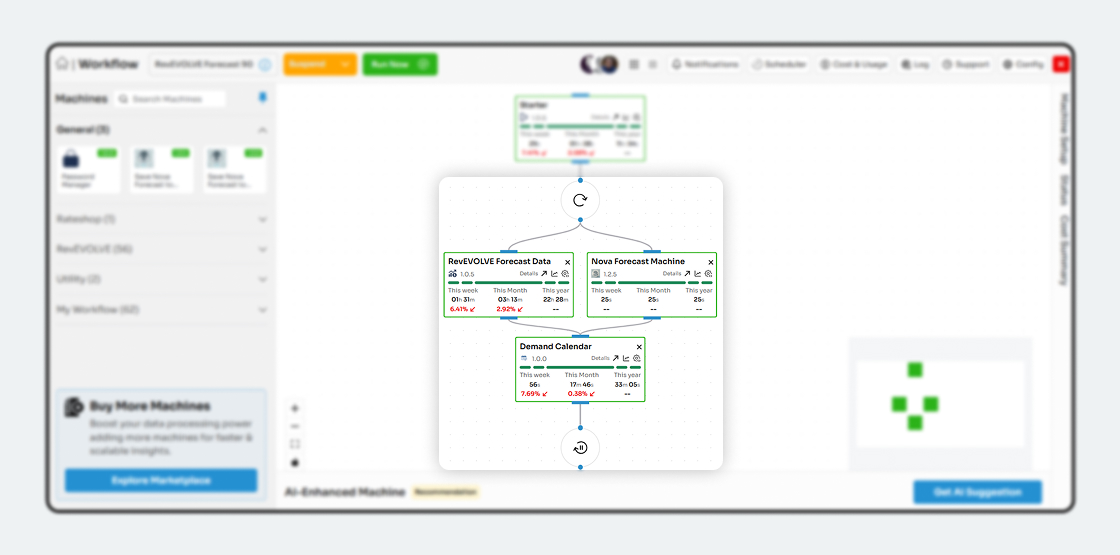
Hotel Switchboard manages data for dozens of properties—each with its own PMS data, OTA rates, and daily operational metrics. In their AWS setup, running all properties in parallel required complex concurrency settings, memory tuning, and retry logic. QuantumDataLytica removed all of that. With its Looping Engine, a single workflow now runs across 50, 100, or even 500 properties in clean, predictable batches. Workflow logic stays identical; QDL simply cycles through every property payload automatically. As a result, Switchboard no longer worries about workload distribution or pipeline overload. The system handles everything behind the scenes.
Nested Workflows
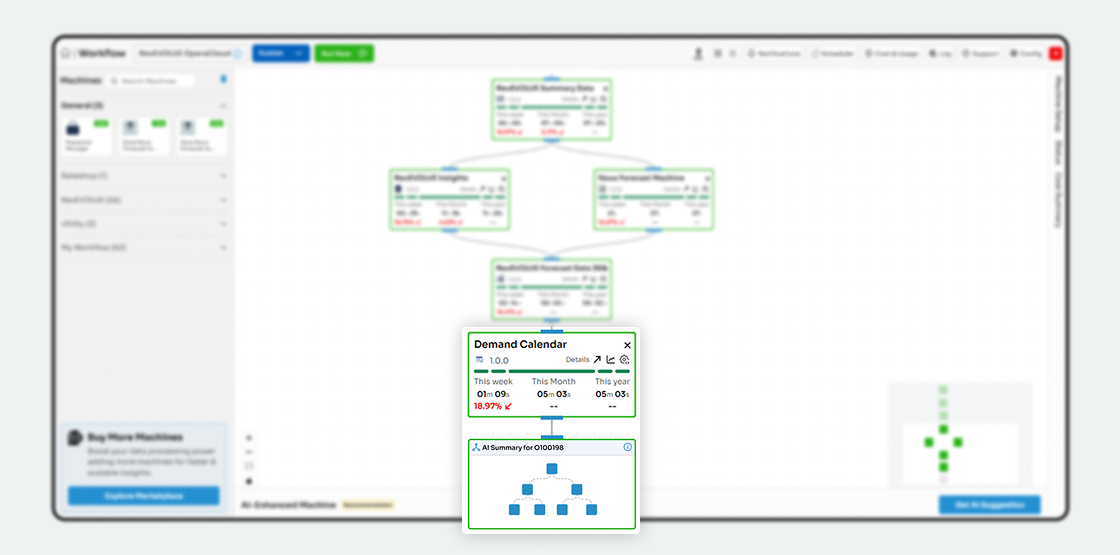
Nested Workflows became the backbone of Switchboard’s new architecture. Instead of rewriting the same transformation logic in multiple different workflows, the team now builds core sub-workflows—such as “Data Quality & Validation,” “OTA Normalization,” or “Dispatch to DB”—and reuses them everywhere. These sub-flows behave like reusable modules. One improvement in a sub-workflow instantly updates every master workflow that depends on it. This eliminated redundancy, simplified maintenance, and brought true modularity to their pipeline ecosystem. For a multi-property platform like Switchboard, this reduced monthly engineering hours significantly.
Conditional Workflows
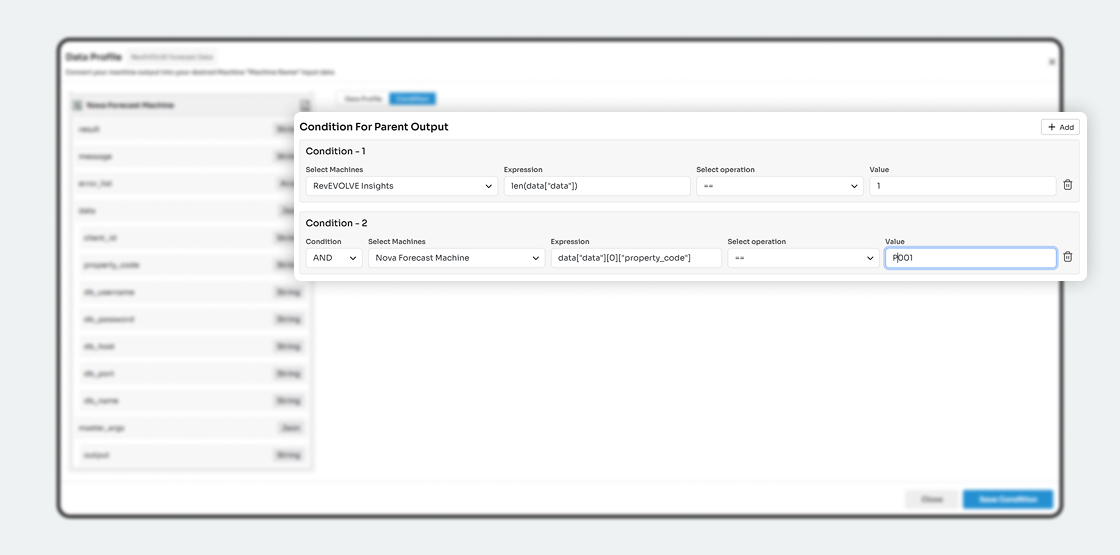
Hotel brands operate differently. Hilton, Hyatt, and IHG all structure rates, taxes, and availability in slightly different formats. Before QDL, Switchboard had separate scripts with brand-specific logic scattered across the system. Now, conditional logic inside workflows makes it easy to route data differently based on property, brand, or payload content. One workflow can serve all properties—branching only when necessary. This standardized the system while preserving flexibility. The engineering team no longer maintains 20 variations of the same logic.
Webhooks
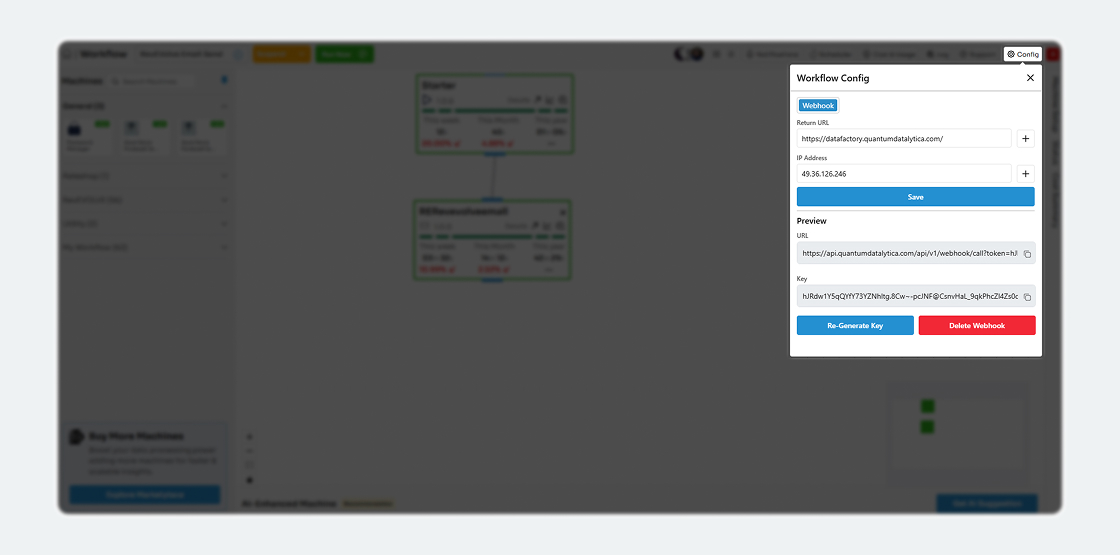
Webhook-based automation fundamentally changed how Hotel Switchboard reacts to real-time data. Instead of relying solely on scheduled jobs, PMS systems and partner tools now trigger workflows instantly through webhooks. For example, new reservations or rate updates can fire a webhook that automatically starts ingestion, cleaning, and dispatch workflows. This reduces latency and ensures the platform always operates on fresh, accurate data. And because QDL handles retries and payload validation internally, Switchboard never has to maintain external queueing or retry systems.
Scheduling Engine
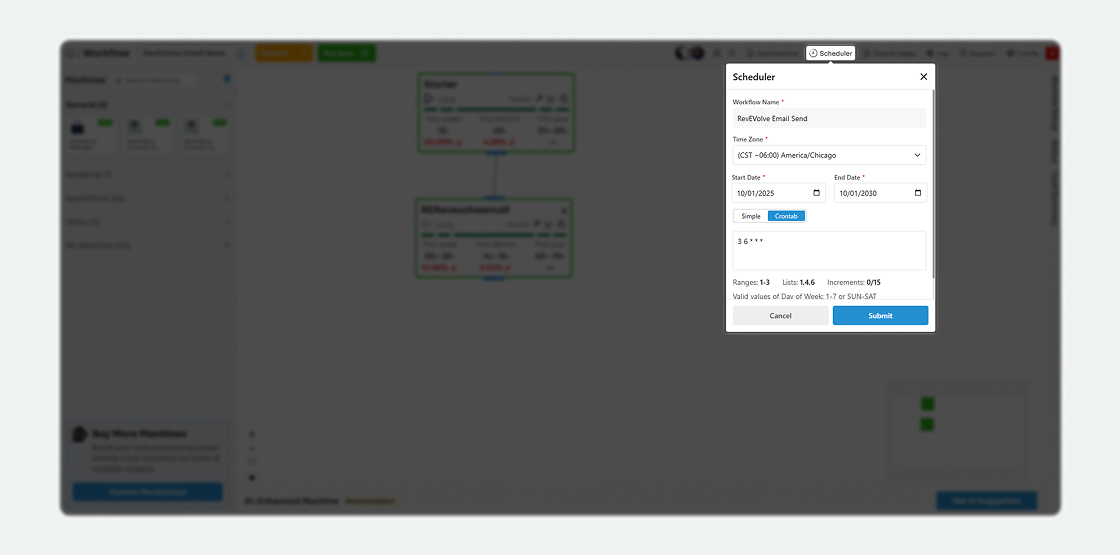
While real-time triggers are useful, Switchboard still runs many daily refresh jobs, rate-shopping cycles, and forecasting routines on a fixed schedule. On AWS, cron-based Lambda triggers were brittle and difficult to monitor. QDL’s scheduling engine solved that: workflows run daily, hourly, or hybrid schedules with full transparency. If a job fails or delays, the team sees it immediately. The scheduler also plays well with Looping and Nested workflows, allowing multi-property pipelines to run with precision—without DevOps involvement.
Centralized Logs & Execution History
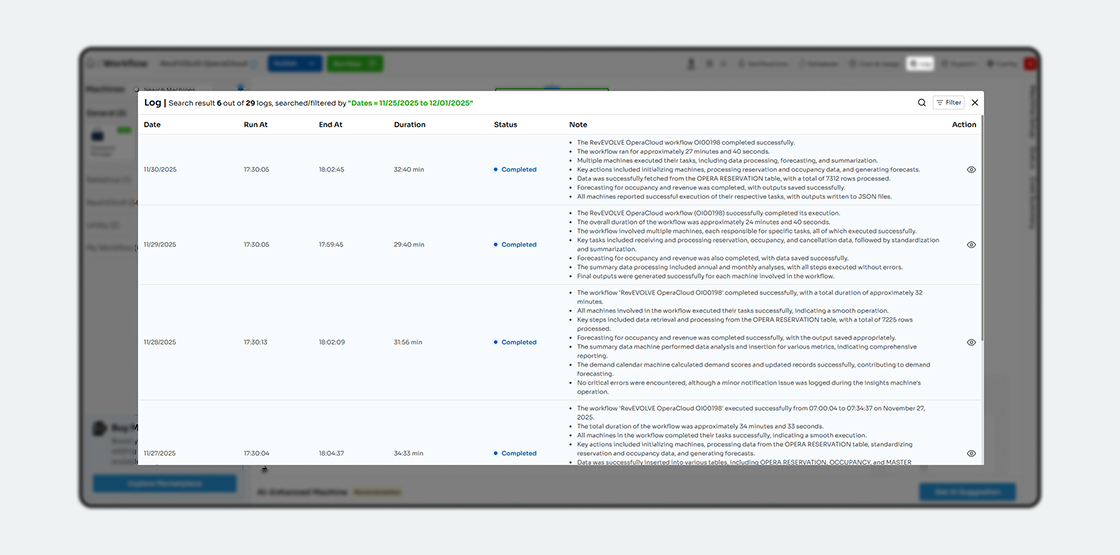
One of the biggest problems with their old setup was debugging. Logs were scattered across CloudWatch, CSV dumps, S3 folders, and internal dashboards. QDL consolidated everything into a single, structured view. Every workflow run shows:
- Inputs and outputs
- Success and failure points
- Machine-level details
- Retries and recovery
- Execution time
- Processed property list
This drastically reduced debugging time and allowed Switchboard’s engineering team to spot issues before they impacted revenue managers or dashboards.
Scalable Orchestration Layer
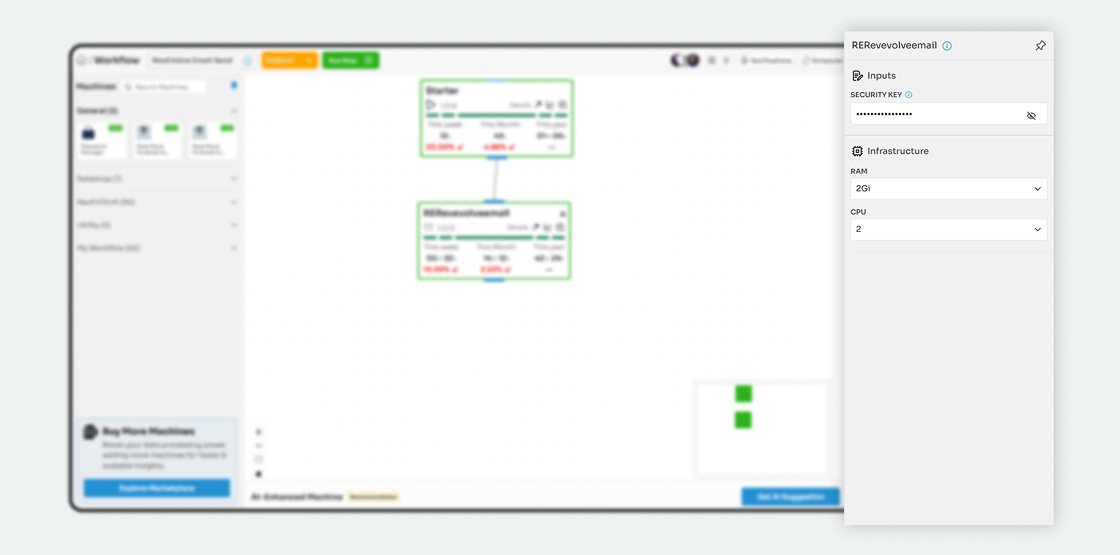
No decisions about CPU, RAM, concurrency, or instance sizing. The platform handled all execution complexity automatically.
The Results (With Numbers)
The shift to QuantumDataLytica delivered measurable, immediate, and long-term gains for Hotel Switchboard. By replacing their AWS-based automation stack with QDL’s fully managed orchestration layer, the team experienced a dramatic improvement in cost efficiency, scalability, and operational performance.
Cost savings were the first major win. Their monthly cloud spend dropped from $5,390 to roughly $2,700, a 51% reduction achieved simply by eliminating EC2 instances, Lambda compute, CloudWatch logs, and custom orchestration scripts. These savings continue to compound as more properties are added.
Infrastructure management disappeared entirely. Hotel Switchboard now operates with 100% infrastructure eliminated, freeing the engineering team from DevOps tasks, server monitoring, scaling scripts, and cloud optimization work. Automation focuses on logic, not hardware.
Scalability became effortless. The platform now handles a projected 500+ properties with zero configuration changes. Whether onboarding a single hotel or a large portfolio, workflow performance and cost remain consistent.
Operational efficiency surged. End-to-end data refresh cycles run significantly faster—OTA rates, PMS extracts, and forecasting models execute with greater consistency, producing reliable outputs for BI dashboards and revenue teams.
Reliability improved dramatically. Workflow uptime now sits at 99.99%, driven by QDL’s retry engine, batch processing, nested workflows, and centralized log management. Failures are rare, visible, and auto-recoverable.
Internal productivity jumped. With DevOps overhead removed, engineers spend more time improving data models, building new automation, and expanding hotel-specific workflows instead of patching and maintaining infrastructure.
Together, these outcomes transformed Hotel Switchboard’s data automation into a scalable, low-cost, high-reliability engine—ready for aggressive growth across hundreds of properties.
Use Cases Enabled
Migrating to QuantumDataLytica didn’t just fix Hotel Switchboard’s infrastructure problems — it opened the door to entirely new use cases that were difficult, expensive, or impossible to manage under their AWS-driven setup. With a unified, no-code workflow engine and modular reusable components, the platform now delivers automation capabilities at a scale that supports hotel operations, revenue management, and BI teams across hundreds of properties.
One of the most impactful upgrades was in multi-property data ingestion and normalization. Instead of separate scripts for each hotel, a single workflow now ingests PMS data, cleans it, validates the schema, and dispatches it to storage for all properties at once. This created a clean, standardized data foundation across the entire Switchboard portfolio.
The second major use case is automated rate-shopping pipelines. With marketplace connectors for LightHouse, RateGain, RateMatrix, Booking.com, Hotels.com, Expedia, Hilton, Hyatt, and IHG, rate extraction now runs in parallel batches across dozens of properties. Results arrive faster, cleaner, and in a standardized format ready for competitive pricing intelligence and parity checks.
Forecasting also improved dramatically. With Nova Forecast, Hotel Switchboard now generates daily occupancy predictions for every property without maintaining a single model on AWS. These forecasts feed into revenue strategy dashboards and daily executive briefings, giving revenue managers a clearer view of demand patterns and pacing trends.
A fourth use case is AI-powered insights and reporting. Nova AI Automation transforms raw hotel datasets into ready-to-read summaries — highlighting anomalies, guest behavior patterns, parity issues, and forecasting deviations. This eliminated manual reporting cycles and gave managers actionable intelligence in real time.
The engineering team also built multi-step conditional workflows that adjust processing based on brand-specific logic, OTA nuances, or property-level rules. This flexibility allows the same workflow to serve Hilton, Hyatt, IHG, and independent hotels without creating multiple pipeline versions.
Finally, the adoption of webhook-triggered workflows unlocked real-time automation. PMS updates, new reservations, or OTA rate changes can now trigger ingestion and processing instantly, creating an always-fresh data ecosystem that improves decision-making across the board.
Collectively, these use cases position Hotel Switchboard as a highly scalable, automation-first hospitality platform — capable of onboarding hundreds of properties while maintaining speed, accuracy, and operational consistency.
Recent Use Cases
-
02 Jun, 2026
A no-code data engineering platform, proven in production.
-
01 Dec, 2025
How Hotel Switchboard Cut Cloud Costs by 51% and Scaled to 500+ Properties Using QuantumDataLytica
-
27 Aug, 2025
How We Helped a Healthcare Digital Marketing Firm Automate 10K+ Social Posts With 99.99% Success & 75% Cost Reduction
-
09 Apr, 2025
How Exitofresh Supermarket Accelerated Operational Efficiency with QuantumDataLytica
-
09 Feb, 2025
Automating Hotel Rate Shopping with QuantumDataLytica
Testimonial
Migrating to QuantumDataLytica has transformed the way we operate. We no longer think about servers, scaling, or infrastructure — everything just runs. Our AWS costs dropped by more than half, our workflows are more reliable than ever, and onboarding new properties has become effortless. What used to take weeks of engineering time now happens in hours. QuantumDataLytica has become the backbone of our automation strategy and a key driver of our growth.
— Jigar Patel CEO @ Hotel Switchboard LLC, IL, USA