


Webhook vs. API: Which Trigger Works Best in QuantumDataLytica Workflows?
If you’ve ever built an automation or data pipeline, you’ve likely faced the same question:
“Should I trigger this workflow with a webhook or an API call?”
It’s a small choice with big implications. Pick the wrong one, and you might end up with delayed data syncs, redundant jobs, or missed events. Pick the right one, and your workflow runs like clockwork — every time.
At QuantumDataLytica, where data flows across hundreds of systems and modular “Machines,” understanding how triggers behave isn’t just technical trivia — it’s the difference between instant orchestration and scheduled processing.
Let’s break it down, simply.
The Core Difference
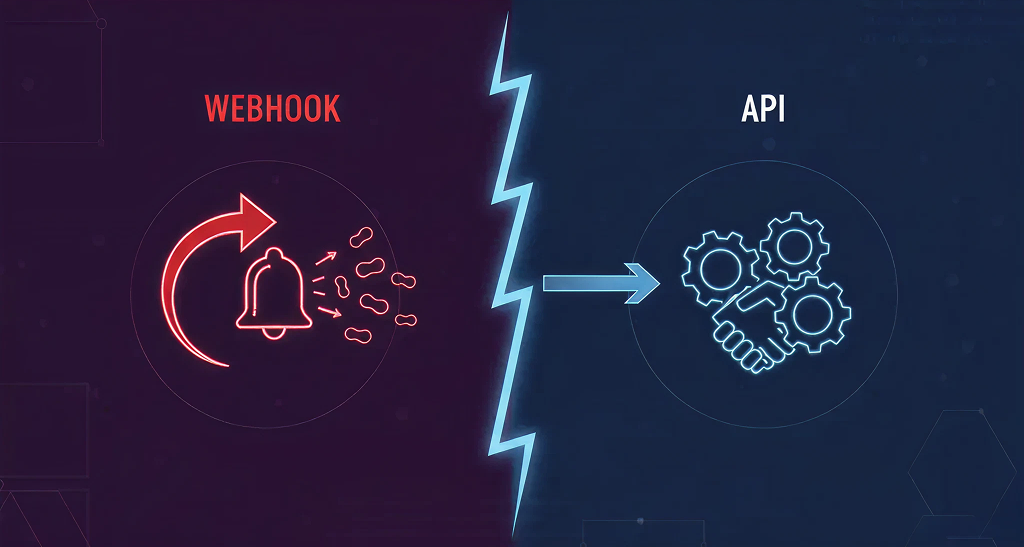
Think of an API as a phone call you make when you want something.
You dial, wait for the other end to answer, get the data, hang up.
A webhook, on the other hand, is a notification someone sends you the moment something happens. You don’t ask — it tells you.
In technical terms:
- APIs are pull-based — your workflow requests data at defined intervals.
- Webhooks are push-based — the source system automatically pushes data to your workflow when an event occurs.
How QuantumDataLytica Uses Both
QuantumDataLytica supports both webhook and API triggers, giving teams the freedom to choose depending on how critical timing, data freshness, and system control are.
When a client integrates multiple systems — say, a CRM like Salesforce, a marketing automation tool, and a reporting dashboard — each “Machine” in the workflow can be set to start either by a webhook (event-driven) or API (scheduled pull).
Here’s how they play out in real-world automation.
When a Webhook Trigger Works Best
Imagine your CRM receives a new lead from your website. You want that data to flow instantly into your data pipeline, enrich it with external information, and send a Slack notification to the sales team.
That’s where webhooks shine.
As soon as the form is submitted, the webhook fires a payload directly into QuantumDataLytica, triggering the “Lead Enrichment Machine.” The process begins within milliseconds.
Best for:
- Real-time event-driven workflows
- Notifications, lead generation, or customer actions
- Scenarios where every second matters
In QuantumDataLytica, webhook triggers ensure zero delay between event and action, ideal for high-speed business use cases like marketing automation, IoT alerts, or instant data ingestion.
When an API Trigger Works Better
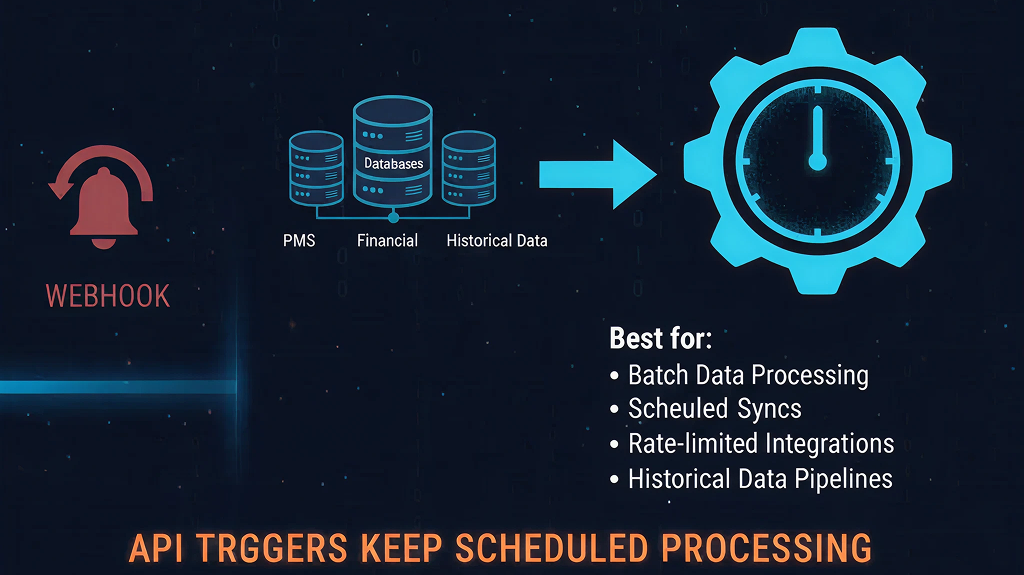
Now imagine you’re syncing nightly data from a Property Management System (PMS) or financial database. You don’t need real-time updates; you just want a consistent, reliable pull of data.
That’s an API trigger.
Your QuantumDataLytica pipeline makes a scheduled call to fetch the latest records — say, every hour or once a day — ensuring data is up to date without overwhelming your systems with constant activity.
Best for:
- Batch data processing and scheduled syncs
- Integrations with rate limits or access restrictions
- Historical or analytical data pipelines
API triggers keep things predictable, resource-efficient, and under your control.
Hybrid in Action: The QuantumDataLytica Advantage
Here’s the magic: you don’t actually have to choose one over the other.
QuantumDataLytica allows hybrid workflows, combining webhook and API triggers seamlessly. For example:
- A webhook triggers immediate updates when new leads arrive.
- An API trigger runs hourly to reconcile any missed or delayed data.
This hybrid approach guarantees 100% data coverage — no blind spots, no missed events, no manual reconciliations.
It’s part of how QuantumDataLytica achieves 99.99% workflow reliability, even across complex multi-system environments.
Real Example: Revenue Insights at Speed
One hospitality client uses QuantumDataLytica to manage pricing data across multiple channels.
- Webhooks fire instantly when a new booking or rate change occurs on OTA platforms.
- API calls run nightly to fetch complete booking reports and reconcile discrepancies.
This dual setup means real-time reaction (pricing and alerts) and long-term accuracy (reporting and forecasting) — a perfect balance between immediacy and completeness.
So, Which Trigger Should You Use?
The answer depends on what you’re trying to achieve.
If you need speed and real-time action, choose webhooks.
If you need reliability, history, or control over timing, choose APIs.
In QuantumDataLytica, both work beautifully together — and because the platform is fully modular and no-code, you can switch between them or combine both with a few clicks.
Automation shouldn’t force you to choose between “fast” and “stable.”
QuantumDataLytica gives you both.
Final Thoughts
In the evolving world of data automation, speed and reliability shouldn’t compete — they should collaborate. Webhooks bring immediacy; APIs bring completeness. Together, they form the backbone of modern, intelligent workflows.
QuantumDataLytica doesn’t just support both; it unifies them. Whether you’re automating CRM updates, processing hotel rate data, or orchestrating IoT feeds, you can design workflows that react instantly, process reliably, and scale effortlessly — all without writing a single line of code.
In the end, it’s not about choosing between webhook or API.
It’s about choosing a platform that gives you the power of both — in one unified flow.
FAQs
A webhook reacts instantly to an external event; an API call is scheduled or manually triggered to fetch data. Both are configurable within the workflow designer.
No. QuantumDataLytica’s no-code interface lets users configure triggers visually. You just define your event source (for webhooks) or endpoint and schedule (for APIs).
Yes — many enterprise clients use hybrid setups. This ensures real-time reactivity while keeping data integrity through periodic API syncs.
The system includes automated retry logic, failover queues, and validation to ensure no data loss — even if the external source fails or times out.
Webhook triggers are lightweight and ideal for real-time tasks, while API triggers consume resources at scheduled intervals. QuantumDataLytica’s orchestration engine balances both for optimal cost and performance.

Nitin Suvagiya is the Architect and Lead Developer of the Quantum-Core-Engine at Quantum Datalytica, driving advanced workflow automation and data analytics solutions. As a DevOps-certified engineer, he specializes in cloud automation, CI/CD pipelines, Kubernetes, and scalable infrastructure. His expertise in software architecture and machine development ensures seamless deployment, high-performance computing, and optimized workflows. Nitin plays a crucial role in building intelligent, data-driven solutions that empower businesses with efficiency, reliability, and innovation in Quantum Datalytica’s ecosystem.
Recent Blogs
-
Workflow Automation 29 Sep, 2026
Build Once, Run Everywhere: Reusable Data Pipelines with QuantumDataLytica
-
Data Management Innovations 22 Sep, 2026
No-Code ETL vs Traditional ETL: The Definitive 2026 Comparison
-
Workflow Automation 09 Sep, 2026
Clinical Trial & IVD Data Automation: Automating Compliant Pipelines End-to-End
-
Personalized Learning 03 Sep, 2026
From One Spreadsheet to Ten Study Plans
-
Workflow Automation 26 Aug, 2026
From HubSpot to Airtable to Inbox in Seconds: The No-Code Deal Sync Workflow, Explained