


Proxy as a Service: Adding Proxy Support to Hundreds of Pipelines Without Changing Code
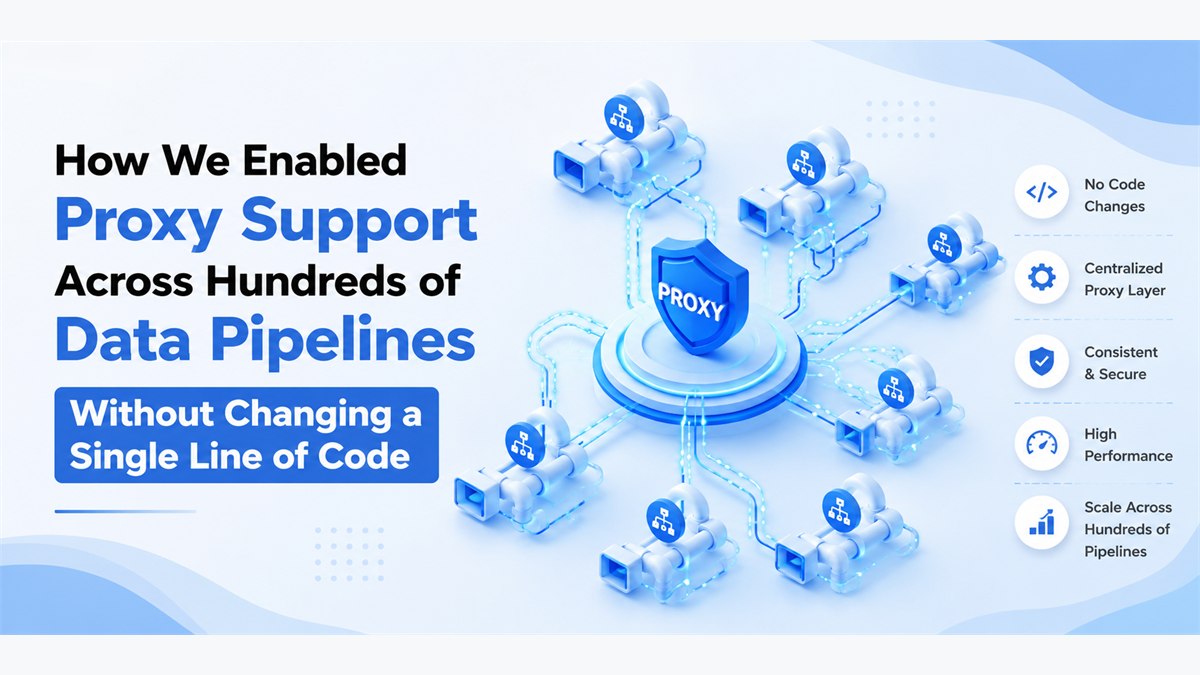
TL;DR – Routing pipeline traffic through a proxy normally means editing every project, wiring in credentials, and re-releasing your applications. Quantum DataFactory’s Proxy as a Service moves that work into the platform. Your machines keep running requests.get(url) exactly as written, while the runtime provisions and routes the proxy at execution time – so hundreds of pipelines gain proxy support with zero code changes.
A Networking Change That Turns Into an Engineering Project
Every data team eventually hits the same wall.
A pipeline that has run cleanly for months suddenly needs to route its outbound traffic through a proxy. Maybe a customer needs geographically distributed IP addresses. Maybe outbound reliability against public web sources has become business-critical. Maybe a new enterprise networking or compliance policy simply requires it.
The business reason changes every time. The engineering tax rarely does.
Because on paper, “route our traffic through a managed proxy” sounds like a configuration switch. In practice, when your data automation lives across dozens or hundreds of pipelines, it becomes something much larger.
The Hidden Cost of a “Simple” Proxy Request
Picture an organization running hundreds of automated data pipelines. Somewhere inside each one is code that looks like this:
response = requests.get(url)It works. It has worked for months. Then a customer asks: “Can we route all outbound traffic through a managed proxy service?”
Now that one-line request cascades into real work:
- Updating every project that makes outbound calls
- Modifying HTTP client configuration in each one
- Managing and rotating proxy credentials
- Re-testing every deployment
- Releasing new application versions
- Maintaining different proxy configurations across dev, staging, and production
Nothing about the business logic has changed. The pipelines still do exactly what they did yesterday. Yet the engineering team is now touching working code across the entire estate – because a networking requirement has leaked into application development.
That leak is the actual cost. It is slow, it is risky, and it repeats every time the infrastructure layer shifts.
A Networking Change Shouldn’t Require an Application Change
At QuantumDataLytica, we kept coming back to one question: why should developers modify working application code just because the networking layer changed?
If the business logic hasn’t changed, the software shouldn’t have to. Developers shouldn’t have to rewrite this –
# Before: proxy logic embedded in every machine
response = requests.get(url, proxies=proxy_config)
– when this should simply keep working, untouched:
# After: the machine stays exactly as written
response = requests.get(url)
No new libraries. No new APIs. No refactor. No migration project.
How Proxy as a Service Works in Quantum DataFactory
That principle is what led us to Proxy as a Service in Quantum DataFactory.
Instead of embedding proxy logic inside every Quantum Machine, we moved the responsibility into the platform itself. Enabling proxy support is now a platform configuration, not a code change:
- The workflow decides whether a given machine should run through a proxy.
- The runtime provisions everything required at execution time.
- The machine code stays completely unchanged.
From the developer’s seat, nothing changes. From the platform’s seat, everything does. Under the hood, Quantum DataFactory now handles:
- Runtime proxy configuration
- Secure credential injection
- Centralized configuration management
- Outbound network routing
- Environment-specific deployment
All of it happens without a single application change – which is the whole point. This is the same separation-of-concerns discipline that principles like the Twelve-Factor App have argued for years: configuration belongs in the environment, not baked into the code.
What This Actually Changes for the Business
The payoff isn’t a nicer developer experience for its own sake. It’s what that experience removes.
| Dimension | Traditional Per-App Proxy | Proxy as a Service (Platform-Managed) |
|---|---|---|
| Where proxy config lives | Inside every pipeline’s code | In the platform / workflow layer |
| Code changes required | Every project edited and re-tested | None – machine code stays as written |
| Credential handling | Managed per project, often hardcoded | Injected securely by the runtime |
| Rolling out to 100s of pipelines | Update, test, and release each one | Enable a platform capability |
| Environment differences | Separate configs maintained by hand | Handled per environment by the platform |
| Regression risk | High – you’re touching working code | Low – no application code is touched |
Now imagine migrating hundreds of existing data automation workflows onto managed proxy infrastructure – not by rewriting code, not by asking developers to update applications, not by maintaining a separate proxy-enabled fork of every pipeline. Simply by enabling a platform capability.
For the people accountable for the estate, that translates directly:
- Faster response to customer and compliance requirements – networking changes stop turning into multi-sprint code projects.
- Lower risk – no code changes means no new regression surface across pipelines that already work.
- Less to maintain – no parallel “proxy-enabled” versions drifting out of sync.
- Predictable rollout – one capability, applied consistently across every environment.
Route hundreds of pipelines through a proxy without a migration project. Talk to our team about enabling Proxy as a Service on your workflows. Contact us.
This Is a Pattern, Not a One-Off Feature
Proxy as a Service matters beyond proxies. It’s a statement about how a modern platform should evolve.
Infrastructure capabilities should be delivered as platform services – provisioned once by the runtime – rather than re-implemented inside every application that needs them. Today that capability is proxy support. Tomorrow it could just as easily be managed secrets, secure storage, AI services, browser infrastructure, distributed execution, or centralized authentication.
The application shouldn’t need to know how any of those services work. It should simply consume them.
That’s the principle underneath Quantum DataFactory: business logic should remain business logic, and infrastructure should remain infrastructure. When those two concerns become tightly coupled, systems get harder to maintain, migrate, and scale. When you separate them, teams gain flexibility without paying for it in engineering hours. We covered the architectural case for this in more depth in why proxy management belongs in the platform, not your code.
It’s the reason Quantum Machines stay small and focused while the platform absorbs the operational complexity around them – an approach that mirrors the wider shift toward platform engineering as a discipline.
The best infrastructure features are usually the ones developers never have to think about. When enabling a major networking capability requires zero application code changes, the platform is doing its job.
Ready to See It on Your Pipelines?
Proxy as a Service is one step toward a platform where developers focus on creating business value while Quantum DataFactory handles the operational complexity behind the scenes.
Request a demo and see Proxy as a Service run against a live workflow. Or explore self-serve: Quantum DataFactory or the Developer Hub to build your first Quantum Machine.
Questions? Reach the team at info@quantumdatalytica.com or +1 (512) 733-3085.
FAQs
Proxy as a Service is a platform capability that lets Quantum Machines route outbound traffic through a managed proxy without any code changes. Instead of embedding proxy logic in each pipeline, you enable it as a configuration and the runtime provisions and routes the proxy at execution time.
No. Your machine keeps calling requests.get(url) exactly as written. No new libraries, no new APIs, and no refactoring are required. The workflow decides whether a machine uses a proxy, and the platform handles the rest.
Credentials are handled by the platform, not hardcoded into each pipeline. Quantum DataFactory injects them securely into the runtime at execution time and manages them from a centralized configuration, so they never have to live inside individual machine code.
Yes. Proxy usage is decided at the workflow level, so you can route specific machines through a proxy while leaving others on direct outbound connections. It is enabled where you need it, not applied blindly across every pipeline.
Yes. The platform supports environment-specific deployment, so proxy configuration can differ across development, staging, and production without maintaining those differences by hand inside application code.
Common reasons include needing geographically distributed IP addresses for a customer, improving reliability when accessing public web resources, and meeting enterprise networking or compliance requirements. The requirement is a networking concern, which is exactly why it belongs in the platform rather than in application code.
No new libraries or APIs are introduced, and developers don't rewrite anything. Because the proxy is provisioned by the runtime rather than coded into each machine, teams avoid the update-test-release cycle that a per-application approach would trigger across every pipeline.
Yes — that's the core benefit. Hundreds of existing workflows can move onto managed proxy infrastructure by enabling the platform capability, without rewriting code, updating applications, or maintaining separate proxy-enabled versions of each pipeline.

Nitin Suvagiya is the Architect and Lead Developer of the Quantum-Core-Engine at Quantum Datalytica, driving advanced workflow automation and data analytics solutions. As a DevOps-certified engineer, he specializes in cloud automation, CI/CD pipelines, Kubernetes, and scalable infrastructure. His expertise in software architecture and machine development ensures seamless deployment, high-performance computing, and optimized workflows. Nitin plays a crucial role in building intelligent, data-driven solutions that empower businesses with efficiency, reliability, and innovation in Quantum Datalytica’s ecosystem.
Recent Blogs
-
Workflow Automation 29 Sep, 2026
Build Once, Run Everywhere: Reusable Data Pipelines with QuantumDataLytica
-
Data Management Innovations 22 Sep, 2026
No-Code ETL vs Traditional ETL: The Definitive 2026 Comparison
-
Workflow Automation 09 Sep, 2026
Clinical Trial & IVD Data Automation: Automating Compliant Pipelines End-to-End
-
Personalized Learning 03 Sep, 2026
From One Spreadsheet to Ten Study Plans
-
Workflow Automation 26 Aug, 2026
From HubSpot to Airtable to Inbox in Seconds: The No-Code Deal Sync Workflow, Explained