


No-Code ETL vs Traditional ETL: The Definitive 2026 Comparison
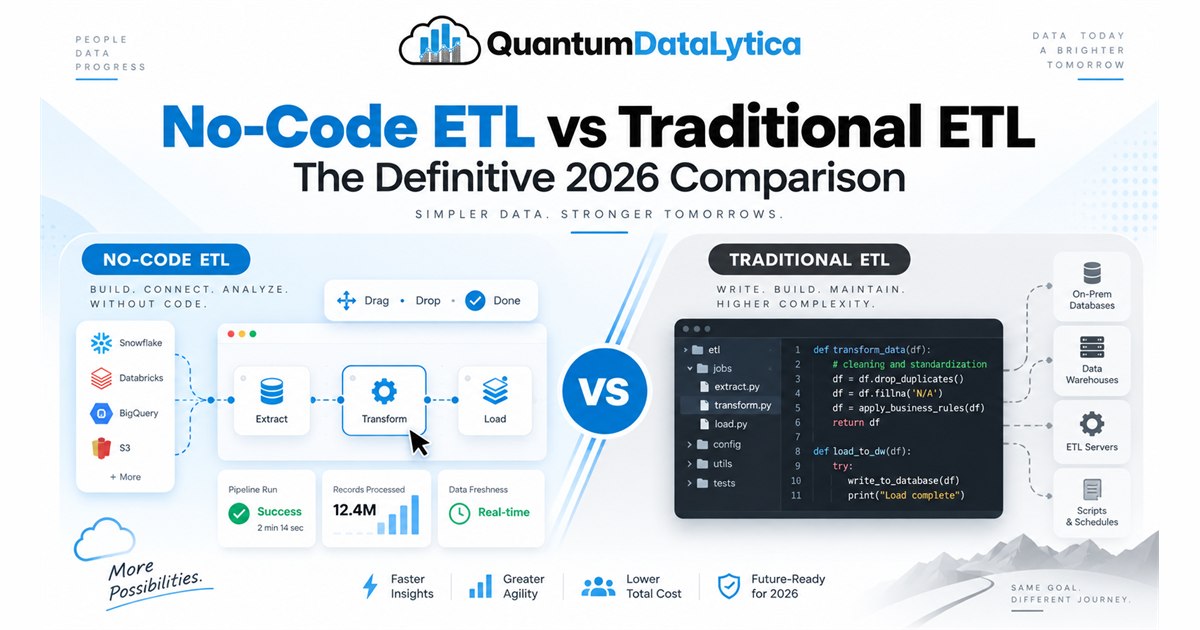
No-code ETL and traditional ETL move the same data – the difference is who builds the pipeline and how much maintenance it demands. Traditional ETL is hand-coded by data engineers: powerful, but slow to change. No-code ETL lets business and operations teams assemble pipelines visually, so a change that once needed an engineering ticket takes an afternoon.
Key Takeaways
- Traditional ETL is code-based and engineer-owned; no-code ETL is visual and can be run by the team that actually owns the data.
- The real cost of traditional ETL is not the build – it is the maintenance every time a source, schema, or business rule changes.
- No-code platforms handle scale and batch through reusable components (Quantum Machines, QuantumLoop), not by trading away performance.
- Traditional ETL still wins for deeply custom logic and heavy transformation that has to live in code.
- Most teams end up hybrid: a no-code spine for the everyday pipelines, custom code for the one or two things that truly need it.
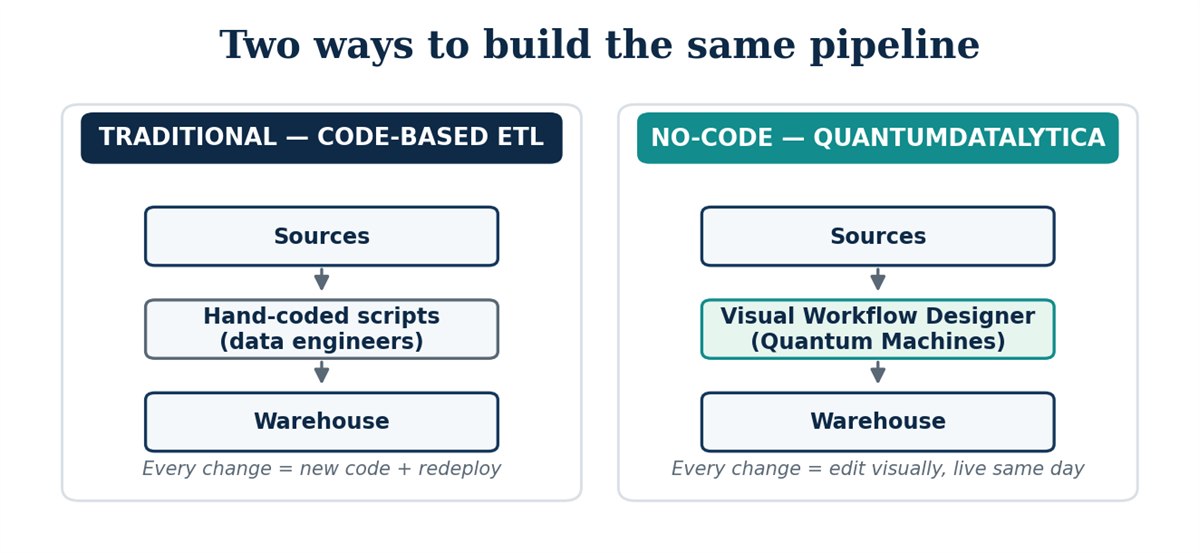
Fig 1 – Traditional (code-based) ETL vs no-code ETL: same data, two build models.
What Is the Difference Between No-Code ETL and Traditional ETL?
No-code ETL and traditional ETL do the same job – extract data from a source, transform it into a usable shape, and load it where it needs to go. The difference is who builds and maintains the pipeline. Traditional ETL is written in code by data engineers. No-code ETL is assembled in a visual interface by the people who own the data, with developers extending it only where custom logic is genuinely needed.
For a business, that difference decides how fast you can respond when a source changes, a report is wrong, or a new vertical needs onboarding. With traditional ETL, every change is an engineering request that waits in a queue. With no-code ETL, the ops team makes the change the same day – which is the real reason teams switch.
How Does Traditional (Code-Based) ETL Actually Work?
Traditional ETL runs on custom scripts. An engineer writes code to connect to each source, defines the transformation logic, schedules the job, and stands up the infrastructure to run it. Tools in this category – the Fivetran, Airbyte, and Talend class of platforms – sit somewhere on the spectrum from fully hand-coded to connector-assisted, but the pipeline itself is still owned and maintained by engineers.
This model is powerful and, for very complex transformations, hard to beat. The catch shows up later. Every source that changes its API, every new field, every altered business rule becomes a code change – specced, written, tested, and redeployed. The pipeline that took three weeks to build takes the rest of its life to maintain, and that maintenance is the line item nobody budgets for.
How Does No-Code ETL Work?
No-code ETL replaces the scripts with a visual builder. On QuantumDataLytica, pipelines are assembled in a drag-and-drop Workflow Designer from reusable components called Quantum Machines – each one a small, tested unit of work you connect together instead of coding from scratch. A revenue manager or an operations lead can build and change a pipeline without waiting on an engineering sprint.
What this means for the business is speed with control. QuantumLoop handles batch and looping work, Nested Workflows keep complex pipelines organized, and real-time monitoring shows what ran and what failed – so the team that owns the data can also own the pipeline, and developers step in through the Developer Hub only for the custom pieces.
A Side-by-Side Comparison
The two models diverge across nine dimensions that decide total cost and speed. The table compares them directly – not against any single named product, but as two ways of building the same pipeline.
| Dimension | Traditional (Code-Based) ETL | No-Code ETL (QuantumDataLytica) |
|---|---|---|
| Who builds it | Data engineers writing and maintaining scripts | Business and ops users in a visual Workflow Designer; developers extend via the Quantum CLI |
| Time to first pipeline | Weeks – spec, code, test, deploy | Days – assemble from existing Quantum Machines and templates |
| Changing a pipeline | A new engineering ticket, then redeploy | Edit visually; the change is live the same day |
| Maintenance burden | High – every source or schema change is code | Low – reconfigure or swap a machine, no redeploy |
| Cost model | Engineer time plus infrastructure you size and pay for | Pay-as-you-go – no pipeline sits idle on a paid cluster |
| Scaling batch & looping | Custom orchestration code | Built in – QuantumLoop and Nested Workflows |
| Monitoring & run history | Depends on what the team instruments | Real-time monitoring at the platform level |
| Flexibility for edge cases | Unlimited – it is code | High for common patterns; custom machines for the rest |
| Best fit | Large engineering teams, deeply bespoke transforms | Lean teams, vertical ops, fast-changing sources |
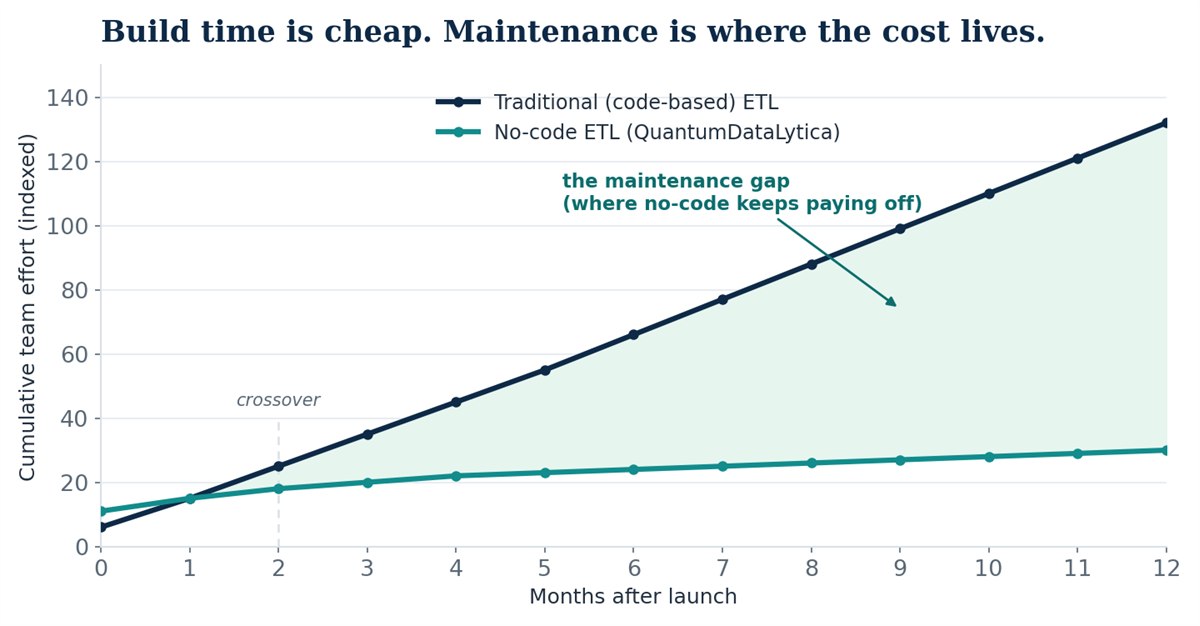
Fig 2 – Where the two models cost you: build time vs. lifetime maintenance.
Is No-Code ETL Slower or Less Scalable Than Traditional ETL?
This is the objection that keeps teams on hand-coded pipelines, and it is mostly outdated. The assumption is that a visual tool must trade away performance for ease. In practice, a no-code platform scales through the same primitives an engineer would build – batching, looping, parallel runs – except they ship with the platform instead of being written per pipeline.
Rule of thumb: if the reason to stay on code is “no-code can’t handle our volume,” test that assumption before you accept it. Looping and batch that a team would hand-build with orchestration code are exactly what a mature no-code platform ships as reusable machines – so scale is usually a configuration question, not a rebuild.
When Does Traditional ETL Still Win?
No-code ETL is not the right answer for every pipeline, and pretending otherwise costs trust. Traditional, code-based ETL is still the stronger choice in a few clear situations – and knowing them is how you avoid forcing the wrong tool onto the wrong job.
| Situation | Why Traditional ETL Fits Better |
|---|---|
| Deeply bespoke transformation logic | When the transformation is genuinely novel and complex, code gives you unlimited control that a visual builder is not meant to replace. |
| A mature codebase and a full engineering team | If pipelines already run well in code and you have the engineers to maintain them, the switching cost may outweigh the gain. |
| Highly specialized performance tuning | Sub-second, hand-optimized streaming logic can warrant a custom-coded path built for that exact workload. |
Even in these cases, the answer is rarely all-or-nothing. Most teams keep code where it earns its place and move the repetitive, high-maintenance pipelines to no-code – which is the hybrid pattern the last section covers.
What Does No-Code ETL Look Like in Practice?
The clearest proof is cost. Hotel Switchboard, a hospitality technology provider, consolidated data operations across more than 500 properties on QuantumDataLytica and cut cloud costs by 51%. The win was not a single clever script – it was removing the per-property engineering maintenance that a code-based approach would have multiplied across every location.
That is the pattern no-code ETL is built for: many similar pipelines that each drift and break in small ways. A reusable Quantum Machine fixes the drift once, everywhere, instead of once per pipeline – which is where the maintenance savings actually come from.
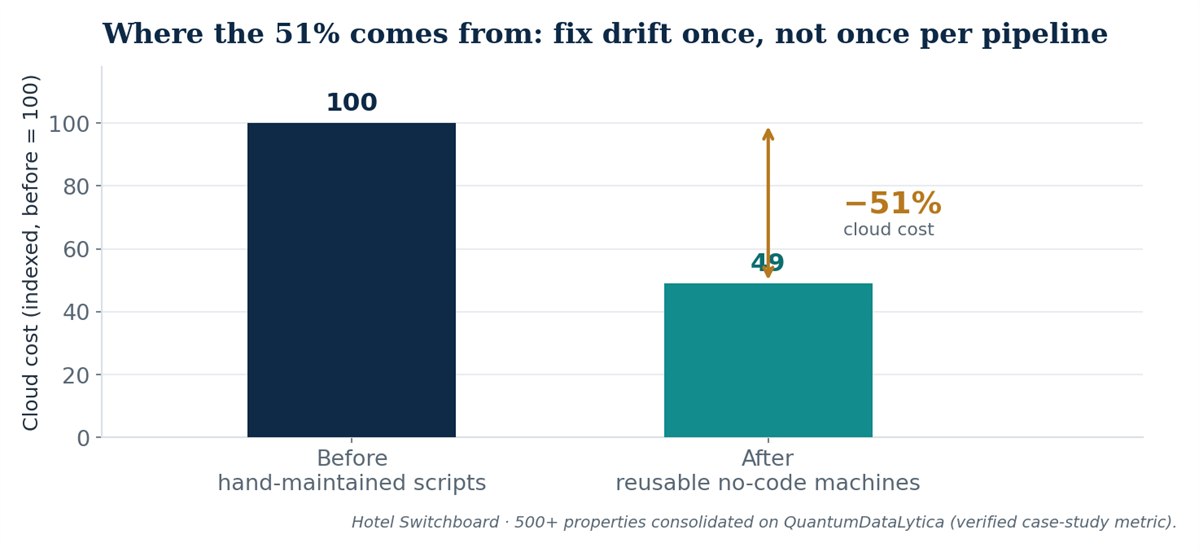
Fig 3 – One reusable machine vs. many hand-maintained scripts: where the 51% comes from.
How Do You Migrate from Traditional ETL to a No-Code Platform?
You do not rip out working pipelines on day one. The safe path is to move the highest-pain pipeline first and prove the model before you scale it.
- Inventory. List your current pipelines and rank them by how often they break or need changes. Maintenance pain, not build effort, is what no-code removes – so start where the pain is.
- Pick one. Choose the highest-pain, lowest-risk pipeline as the pilot. A visible win with a low blast radius earns the team’s trust in the new model.
- Rebuild visually. Recreate it as a workflow in the Workflow Designer, alongside the old one. Nothing is switched off yet – the legacy pipeline keeps running as your safety net.
- Run in parallel. Run both for a cycle and compare outputs row for row. You cut over on evidence, not faith.
- Cut over and repeat. Retire the old script, then move to the next-worst pipeline. Each migration is smaller than the last as the team’s machine library grows.
Which One Should You Choose?
The honest answer is that it depends on your team and how fast your data changes. Use this to place yourself.
Choose no-code ETL if…
- Your sources and rules change often and engineering is a bottleneck.
- The team that owns the data should be able to change the pipeline.
- You want pay-as-you-go cost instead of engineer time plus idle infrastructure.
Choose traditional ETL if…
- You have a full engineering team and pipelines that already run well in code.
- Your core transformations are novel enough to need code-level control.
- You have specialized, hand-tuned performance requirements.
Go hybrid if…
- You run many everyday pipelines plus a few genuinely custom ones.
- You want a no-code spine for speed and custom code where it earns its place.
- This is where most growing teams actually land.
Watch for: the failure mode is treating this as all-or-nothing. Teams that try to move every pipeline at once stall; teams that refuse to move any keep paying the maintenance tax. Start hybrid, move the worst pipelines first, and let the machine library grow.
See It on Your Own Pipelines
Bring your two most painful pipelines to a demo. We will map them to the no-code model and show you where the maintenance time goes.
Request a demo – or call +1 (512) 733-3085 / email info@quantumdatalytica.com.
Related Reading
Compare the platforms directly in QuantumDataLytica vs Traditional ETL Tools, see how QuantumLoop automates no-code workflows, or understand webhooks vs APIs for data automation.
FAQs
For the pipelines most teams run every day, yes. No-code platforms scale through the same batching, looping, and parallel-run primitives an engineer would build - they just ship with the platform. Traditional ETL keeps an edge only for genuinely novel, deeply custom transformation logic.
No - it changes what they work on. Engineers stop maintaining brittle connector scripts and spend their time on the custom machines and hard problems that actually need code, while business teams handle the everyday pipeline changes themselves.
Often, once you count the full cost. Hand-coded ETL adds engineer maintenance time plus infrastructure you size and pay for whether it runs or not. QuantumDataLytica is pay-as-you-go, so a pipeline that is idle is not billing you for a running cluster.
Yes. Batch and looping are handled by QuantumLoop, and complex multi-step jobs stay organized through Nested Workflows - so high-volume and repetitive workloads are a configuration task, not a reason to fall back to code.
ETL transforms data before loading it; ELT loads raw data first and transforms it in the destination. No-code refers to how the pipeline is built (visually vs. in code), not the order of operations - a no-code platform can run either pattern.
Per pipeline, days rather than weeks - especially when the workflow maps to an existing template. The recommended path is one pipeline at a time, run in parallel with the old one until the outputs match, then cut over.
QuantumDataLytica is designed to support HIPAA-aligned data workflows, with real-time monitoring and run history at the platform level. Confirm the specific controls and any BAA requirements for your regulatory context before onboarding sensitive data.
Yes. The Developer Hub lets Python developers build custom Quantum Machines via the Quantum CLI, which then drop into the same visual workflows the business team uses - so you get no-code speed without losing the ability to code the hard parts.

Nitin Suvagiya is the Architect and Lead Developer of the Quantum-Core-Engine at Quantum Datalytica, driving advanced workflow automation and data analytics solutions. As a DevOps-certified engineer, he specializes in cloud automation, CI/CD pipelines, Kubernetes, and scalable infrastructure. His expertise in software architecture and machine development ensures seamless deployment, high-performance computing, and optimized workflows. Nitin plays a crucial role in building intelligent, data-driven solutions that empower businesses with efficiency, reliability, and innovation in Quantum Datalytica’s ecosystem.
Recent Blogs
-
Data Management Innovations 22 Sep, 2026
No-Code ETL vs Traditional ETL: The Definitive 2026 Comparison
-
Workflow Automation 09 Sep, 2026
Clinical Trial & IVD Data Automation: Automating Compliant Pipelines End-to-End
-
Personalized Learning 03 Sep, 2026
From One Spreadsheet to Ten Study Plans
-
Workflow Automation 26 Aug, 2026
From HubSpot to Airtable to Inbox in Seconds: The No-Code Deal Sync Workflow, Explained
-
Workflow Automation 20 Aug, 2026
Compute as a Service: Dedicated VMs for Workflow Execution