


Build Once, Run Everywhere: Reusable Data Pipelines with QuantumDataLytica
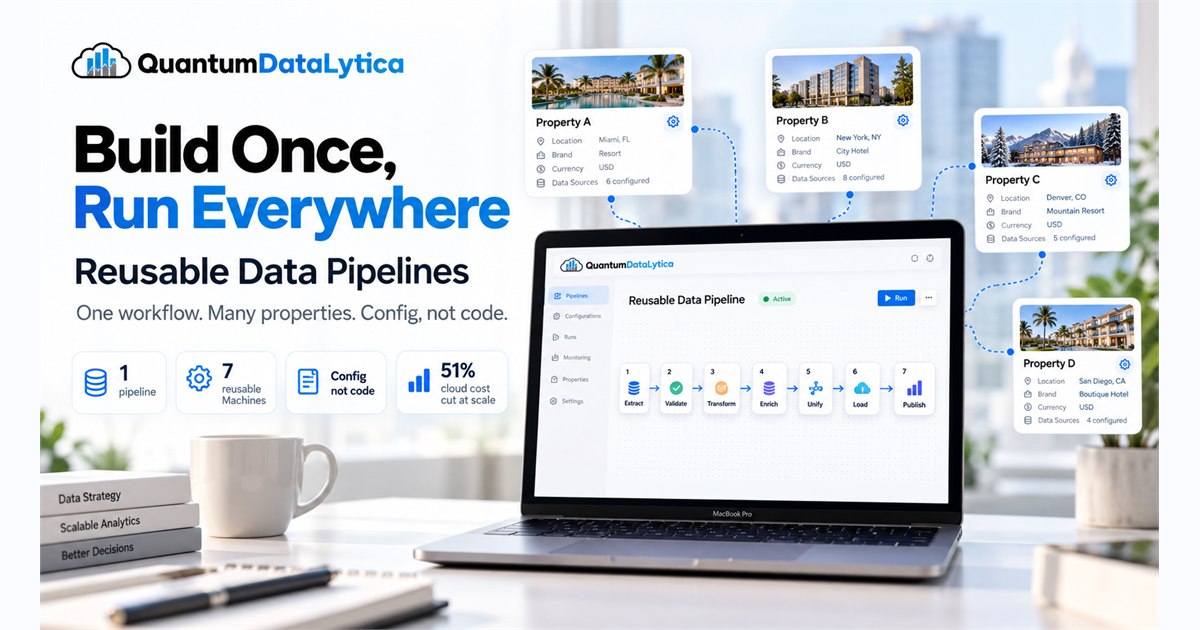
Reusable data pipelines let you build a data process once and run it across many customers, properties, or business units by changing configuration instead of code. On QuantumDataLytica, each processing step is a reusable Quantum Machine; you connect them visually into a workflow, then apply that same workflow wherever the process is needed – so onboarding the next property becomes a configuration step, not a new build.
Key Takeaways
- Package each processing step as a reusable Quantum Machine, then connect them visually into a workflow – the workflow is the pipeline.
- Build the pipeline once and run it across many properties or customers; only the configuration changes, not the code.
- Onboarding the next property becomes a configuration step, not a rebuild – so operational cost stops scaling with every new customer.
- Version individual Machines independently, so improving one step never means redeploying the whole pipeline.
- Pay for workflow execution when it runs, instead of paying for servers that sit idle between jobs.
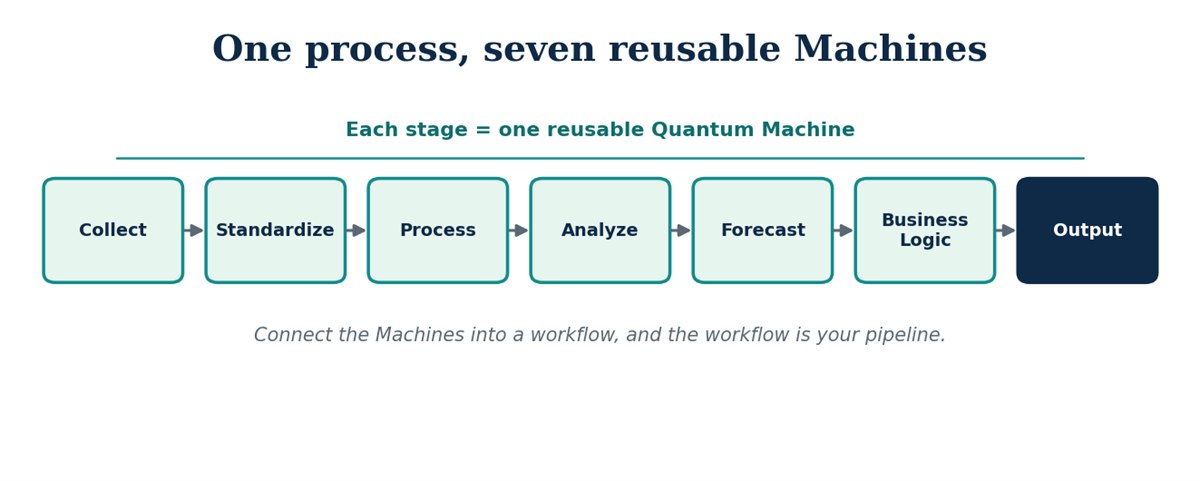
Fig 1 – One process, built as seven reusable Machines connected into a single workflow.
What Does “Build Once, Run Everywhere” Mean for Data Pipelines?
It means building a data process one time and running it across many customers, properties, or locations by changing only the configuration – the credentials, sources, and settings – instead of rewriting the code each time. The pipeline is the reusable asset; where and for whom it runs is just configuration.
For the business, that is the difference between an operation that gets heavier with every new customer and one that barely notices the next ten. You stop rebuilding your technology stack for each account and start onboarding new workloads onto an architecture you have already built.
Why Do Conventional Data Pipelines Get Harder to Manage as You Grow?
Most teams already have the code they need – one script collects data, another cleans it, another runs the model, another prepares the output. The hard part is everything around that code: what runs first, what depends on what, how it is deployed, and how you stand it all up again for the next customer.
Conventional setups solve this with custom scripts, cron jobs, servers, and hand-configured containers. That works for a handful of pipelines. At fifty, or a hundred customers, it becomes a maintenance burden that grows every time the business does – which is exactly the cost reusable pipelines are designed to remove.
What Is a Quantum Machine, and Why Build in Modules Instead of Monoliths?
A Quantum Machine is a single, reusable unit of processing – a scraping step, a transformation, an analytics model, a report generator – packaged so it can be connected to others. Instead of one large application that owns an entire process, you build small, independent pieces and assemble them.
The payoff is focus and reuse. Your developers keep building the logic that differentiates your product, and QuantumDataLytica handles the orchestration around it – while a Machine built for data standardization today becomes a building block in several different pipelines tomorrow.
How Do You Design a Pipeline Visually, Including Non-Linear Dependencies?
Once your Machines exist, you connect them in the Workflow Designer instead of burying the dependencies inside scripts and config files. The workflow is a visual picture of the process, which means a new team member can understand it without reading hundreds of lines of orchestration code.
Real pipelines are rarely a straight line. A stage may depend on several upstream Machines, or one output may feed several downstream steps – so the workflow is a DAG (a directed acyclic graph). Each stage runs when the stages it depends on are done, which lets branches process in parallel and merge cleanly. The same principle underpins nested workflows, which keep complex pipelines organized as they grow.
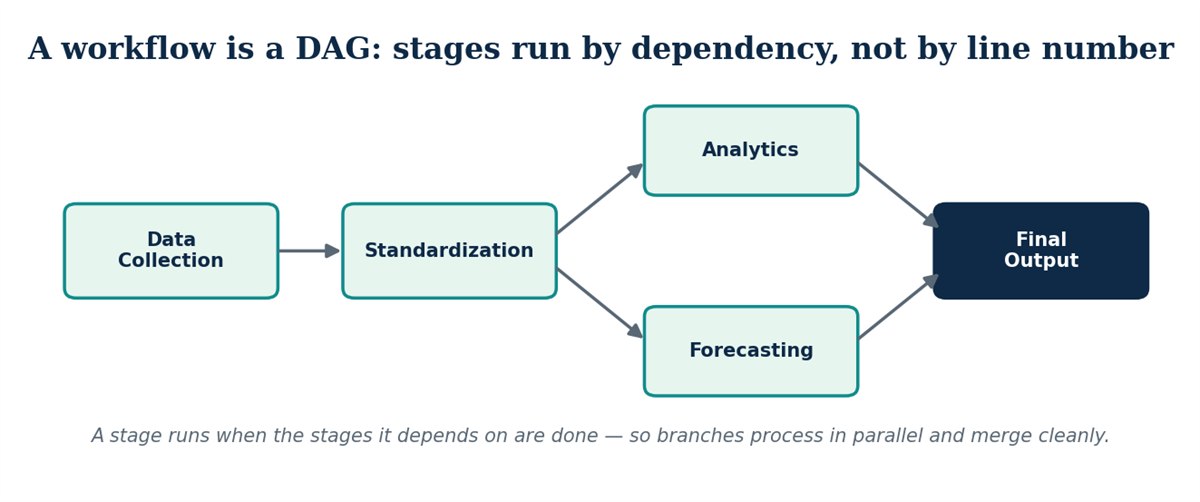
Fig 2 – A DAG workflow: Analytics and Forecasting run in parallel off the same standardized data, then merge.
How Does One Pipeline Run Across Many Properties or Customers?
This is where reuse pays off. Picture a hospitality operator running the same nightly process across 100 properties – collect, standardize, process, analyze, forecast, report. Every property runs the identical process; the only real difference is its credentials, sources, and settings.
Built the conventional way, that quietly becomes 100 near-identical implementations to maintain. Built as a reusable pipeline, it is one workflow applied 100 times, with configuration doing the work code used to do. The engineering team designs the pipeline; the operations team runs it wherever it is needed.
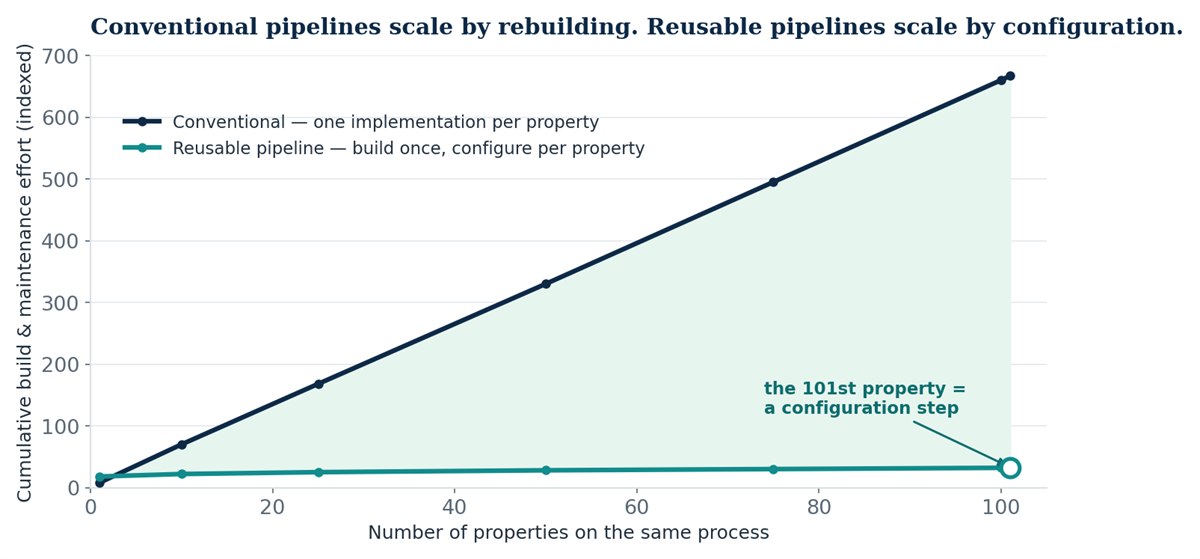
Fig 3 – Conventional pipelines add build effort with every property; a reusable pipeline stays flat.
This is not hypothetical. Teams already run this pattern in production across large property portfolios on QuantumDataLytica – onboarding each new property as configuration rather than a new engineering project, and getting the same process live faster every time.
What Happens When You Onboard the 101st Property?
With conventional pipelines, the 101st property means copying code, configuring servers, creating scheduled jobs, setting environment variables, and re-validating integrations – a small build every time. The cost of growth never goes away.
With a reusable pipeline, onboarding the 101st property means using the pipeline you already have, providing that property’s configuration, and running it. You are not rebuilding your stack for each new customer – you are adding a workload to an architecture that already exists, which is what keeps the cost curve flat as you scale.
Proven at scale: one hospitality operator consolidated data operations across 500+ properties on a single reusable pipeline on QuantumDataLytica – and cut cloud costs by 51%. The saving came from running one workflow everywhere instead of maintaining a separate implementation per property.
How Do You Improve a Pipeline Without Rebuilding It?
In a monolithic application, changing one part often means testing and redeploying the whole thing. With modular Machines, each step evolves on its own – so improving your analytics step does not put the rest of the pipeline at risk.
QuantumDataLytica supports Machine versioning, so you can move a component from one version to the next without touching the pipeline around it. For the business, that means faster, lower-risk improvements: you upgrade the one step that needs it, not the entire system.
How Does Workload-Driven Execution Cut Cost, and How Do You See Inside the Pipeline?
Many data pipelines are workload-driven – they run each morning, every few hours, or when new data arrives, not around the clock. QuantumDataLytica allocates resources around workflow execution rather than keeping a server running for every component, so you pay for processing when it happens instead of for idle infrastructure.
Automation without visibility is hard to operate, so the workflow gives you Machine-level observability. When a run takes longer than expected, you can see which Machine is slow, which version ran, and where a run failed – which turns a long debugging hunt into a quick look at the one stage that needs attention.
Who Builds Machines, and Who Builds Workflows?
The architecture also separates responsibilities. Developers build, test, and publish Machines through the Developer Hub – the specialized capabilities. A workflow team then assembles those Machines into processes, without rebuilding each customer pipeline from scratch.
As the Machine library grows, new workflows reuse existing components instead of starting from zero. That is how a collection of scripts turns into a platform: the more you build, the less each new pipeline costs to stand up.
Why Does This Matter at Scale?
For five workflows, custom automation feels manageable. For hundreds of customers or recurring pipelines, duplicated infrastructure and orchestration become a real engineering liability. The reusable-pipeline model removes that by changing what you maintain – an architecture, not a hundred copies of it.
| As You Grow to Many Properties | Conventional Pipelines | Reusable Pipeline (QuantumDataLytica) |
|---|---|---|
| Onboarding a new property | A small build – code, servers, jobs, integrations | A configuration step on an existing workflow |
| Changing one processing step | Retest and redeploy around it | Version that one Machine independently |
| Infrastructure | Servers running whether work happens or not | Resources allocated around workflow execution |
| Visibility | The pipeline is a black box | Machine-level view of time, version, and failures |
| Cost as you add customers | Grows with every implementation | Stays close to flat – reuse, not rebuild |
Your Business Logic. Your Machines. Your Pipeline.
QuantumDataLytica does not replace the models, algorithms, and domain expertise you already have – those are your most valuable assets. It gives you a way to organize them into modular, executable pipelines that run wherever the business needs them.
Build the Machine once. Connect it once. Build the pipeline once. Then run that architecture across every property, customer, and dataset you add – without redesigning it each time you grow.
See It on Your Own Process
Bring one process you run across multiple properties or customers. We will map it to reusable Machines and show you what onboarding the next one looks like as configuration.
Request a demo – or call +1 (512) 733-3085 / email info@quantumdatalytica.com.
Related Reading
See how QuantumLoop automates batch and looping workflows, and how no-code ETL compares to traditional ETL.
FAQs
A reusable data pipeline is a data process you build once and run across many customers, properties, or business units by changing configuration instead of code. The workflow stays the same; only the inputs and settings change.
A Quantum Machine is a single, reusable unit of processing on QuantumDataLytica - a transformation, a scraping step, an analytics model, a report generator - that you connect to other Machines to build a pipeline.
Scripts and cron jobs solve one pipeline at a time and multiply as you add customers. A reusable pipeline is designed once and applied everywhere, so you maintain one architecture instead of a separate implementation per property.
Yes. When the process is the same, one workflow runs for every property with property-specific configuration - credentials, sources, and settings. Onboarding the next one is a configuration step, not a rebuild.
A DAG (directed acyclic graph) workflow defines which stages depend on which. A stage runs once its upstream stages are done, so branches can process in parallel and merge - instead of running strictly top to bottom.
Developers build the Machines, but a workflow team connects them visually and operations runs the pipeline across properties. Once the Machines exist, building and running pipelines does not require writing new code.
Each Machine can evolve independently through versions, so you can improve one step and move it forward without redeploying the whole pipeline - which makes upgrades faster and lower-risk.
Pricing is pay-as-you-go, and resources are allocated around workflow execution rather than kept running constantly. Pipelines that run periodically do not bill you for idle servers between runs.

Nitin Suvagiya is the Architect and Lead Developer of the Quantum-Core-Engine at Quantum Datalytica, driving advanced workflow automation and data analytics solutions. As a DevOps-certified engineer, he specializes in cloud automation, CI/CD pipelines, Kubernetes, and scalable infrastructure. His expertise in software architecture and machine development ensures seamless deployment, high-performance computing, and optimized workflows. Nitin plays a crucial role in building intelligent, data-driven solutions that empower businesses with efficiency, reliability, and innovation in Quantum Datalytica’s ecosystem.
Recent Blogs
-
Workflow Automation 29 Sep, 2026
Build Once, Run Everywhere: Reusable Data Pipelines with QuantumDataLytica
-
Data Management Innovations 22 Sep, 2026
No-Code ETL vs Traditional ETL: The Definitive 2026 Comparison
-
Workflow Automation 09 Sep, 2026
Clinical Trial & IVD Data Automation: Automating Compliant Pipelines End-to-End
-
Personalized Learning 03 Sep, 2026
From One Spreadsheet to Ten Study Plans
-
Workflow Automation 26 Aug, 2026
From HubSpot to Airtable to Inbox in Seconds: The No-Code Deal Sync Workflow, Explained