

Quantum-CLI: A powerful CLI to build, run, and test Quantum Machines.

Execute Your Workflow in a Loop with QuantumDataLytica
QuantumLoop is a powerful enhancement to our no-code data automation platform.

QuantumDataLytica vs Traditional ETL Tools: Accelerate Your Data Integration Without Coding
Traditional Extract, Transform, Load (ETL) tools have long been at the core of data integration practices.
QuantumDataLytica: The No-Code Alternative to Traditional ETL
For years, ETL (Extract, Transform, Load) solutions have been the cornerstone of data integration.
Compliant clinical data pipeline with PII masking
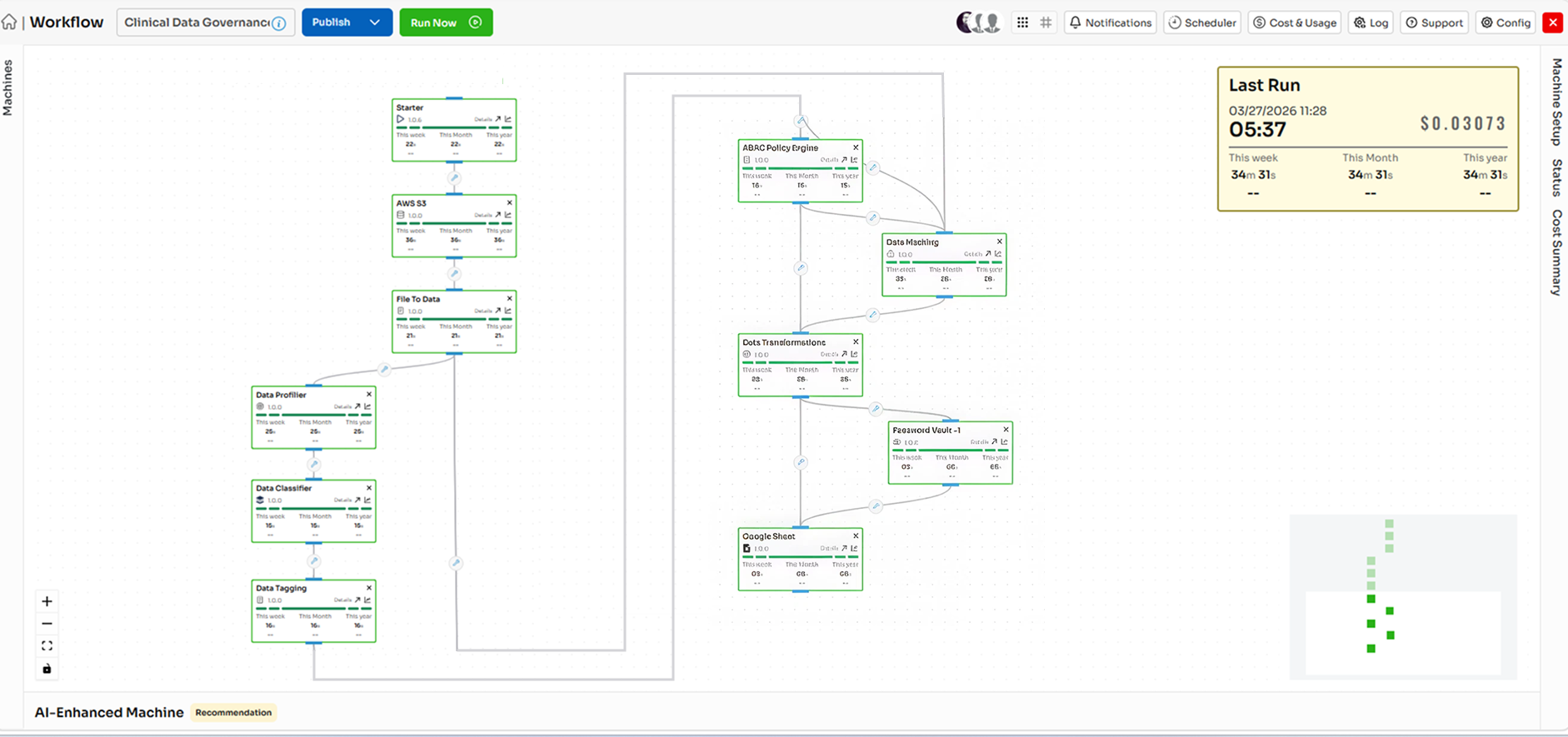
Clinical data is only useful when it's both accessible and protected. This compliance-grade template ingests raw clinical data from AWS S3, classifies and tags PII, enforces role-based access with an ABAC policy engine, masks sensitive fields per role, and delivers a clean, analysis-ready dataset to Google Sheets.
Make clinical data usable - and compliant
Healthcare and life-sciences teams sit on some of the most valuable - and most sensitive - data there is. The challenge is never just moving it; it's moving it compliantly. A doctor, an analyst, and an external partner should each see a different, role-appropriate view of the same clinical dataset, and every access has to be auditable. A general-purpose data pipeline can't do that safely. A clinical data pipeline built for compliance can.
Classify PII, enforce role-based access, mask sensitive fields, and log every access - automatically.
This guide walks through a multi-stage, compliance-grade pipeline you can build on QuantumDataLytica without code. It ingests raw clinical data from AWS S3, profiles it for quality, classifies and tags PII fields like patient name, patient ID, and diagnosis codes, then runs an ABAC policy engine to filter records by authorized role. Sensitive fields are masked for unauthorized roles, the dataset is transformed to each role's needs, and a clean, compliant result is written to Google Sheets.
It's the same secure-integration and compliance capability QuantumDataLytica brings to healthcare - encryption in transit and at rest, field-level masking, and full audit logging - packaged as a template your team can run on a schedule.
Why automate this workflow
What you gain when clinical data pipeline runs on autopilot instead of by hand.
PII classified and masked automatically
A data classifier identifies fields like patient ID and diagnosis codes, and masking redacts them for unauthorized roles - protecting privacy while preserving aggregate analytics.
Role-based access via ABAC
An attribute-based access control engine filters every record to what each role (Doctor, Analyst, and so on) is authorized to see, enforced consistently on every run.
Audit-ready by design
Every access and transformation is logged with role, timestamp, and fields touched, and data is encrypted in transit and at rest to support regulatory audit requirements.
How it works, step by step
Trigger the scheduler
A daily or hourly cron fires and begins the clinical data ingestion pipeline for the configured cycle.
Fetch raw data from S3
The AWS S3 machine downloads the latest raw clinical files (JSON or CSV) from your designated bucket and prefix.
Profile and structure the data
Files are parsed into normalized records, and the Data Profiler analyzes schema, null rates, and anomalies to produce a quality report.
Classify and tag PII
The Data Classifier labels PII fields (patient name, patient ID, diagnosis codes, phone numbers) and tagging marks each field's sensitivity and category.
Enforce ABAC and mask
The ABAC Policy Engine filters records by authorized role, and masking redacts sensitive fields for records accessed by unauthorized roles.
Transform and deliver
The dataset is reshaped to the requesting role's requirements and the final compliant, role-filtered result is written to Google Sheets.
Inputs & outputs
Raw clinical data files (JSON / CSV) stored in your configured AWS S3 bucket
A compliant, masked, role-filtered dataset delivered to Google Sheets
Scheduled (daily or hourly cron, configurable)
PII classification, data tagging, ABAC policy enforcement, and field-level masking
AWS IAM role for S3; Google Sheets API; ABAC role definitions in the policy engine
Best practices
Field-tested guidance for running this pipeline reliably in production.
- Keep the ABAC role configuration current - review and audit role definitions and field-level permissions at least quarterly.
- Log every data access and transformation event, including role, timestamp, and fields accessed, to support regulatory audit.
- Apply masking at the field level rather than the record level where possible, so aggregate analytics survive while individual privacy is protected.
- Validate the Data Profiler output - if null rates or anomalies exceed thresholds, halt the pipeline and raise an alert.
- Ensure the S3 bucket enforces encryption at rest (AES-256) and in transit (TLS) for all clinical data files.
- Run periodic end-to-end tests in staging to verify PII fields are correctly classified and masked for each role.
Secure clinical data, without a data-engineering build
Healthcare providers and research teams use this template to make clinical data usable for analytics without exposing PII or failing an audit. The same dataset serves clinicians and analysts through role-appropriate, masked views - and because QuantumDataLytica handles classification, ABAC, masking, and logging as reusable machines, teams get a compliance-grade pipeline without building one from scratch.
Expected outcome
Clinical data is automatically classified, masked per role, and access-controlled - a compliant, analysis-ready dataset lands in Google Sheets every cycle, ready for authorized users.
Frequently asked questions
What is a clinical data pipeline?
How does PII data masking work here?
What is ABAC and why does it matter for healthcare?
Is the pipeline suitable for compliance and audit requirements?
Can I control how often it runs?
Build clinical data pipeline in minutes - no code
Assemble this workflow from reusable Quantum Machines in the visual Workflow Designer. Pay-as-you-go, no infrastructure to manage.