


Clinical Trial & IVD Data Automation: Automating Compliant Pipelines End-to-End
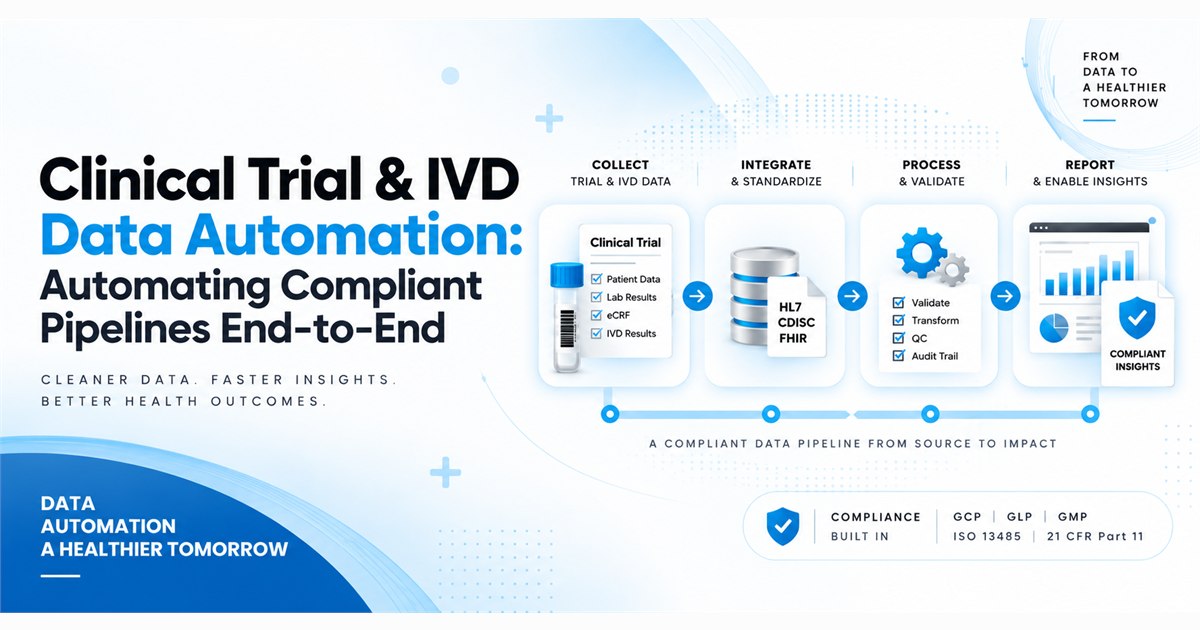
Clinical trial data automation moves study data – from EDC systems, LIMS platforms, instrument feeds, and site uploads – through a governed pipeline of ingestion, validation, audit logging, and submission-ready output, with no manual copy-paste between stages. Done well, it shortens database lock, cuts query cycles, and preserves a defensible audit trail.
Key Takeaways
- Manual clinical data workflows fail at scale because they can’t produce a defensible audit trail – not because people are slow.
- The compliant pipeline pattern has four stages – ingestion, validation, audit, submission – and each has to be automated for the whole thing to hold up under inspection.
- IVD studies add instrument-generated data and specimen-level reconciliation that make manual workflows especially brittle.
- Compliance frameworks (21 CFR Part 11, GxP, HIPAA-aligned handling) apply to the pipeline itself, not just the storage systems on either end.
- Template-based no-code workflows let clinical ops launch these pipelines without a Python team, with a Developer Hub layer for edge cases.
What Is Clinical Trial Data Automation?
Clinical trial data automation replaces the manual handoffs between systems that create most of the risk in a study. Instead of a data manager exporting a CSV, running formulas, and re-uploading somewhere, the pipeline moves the data itself – under governance – from source to submission.
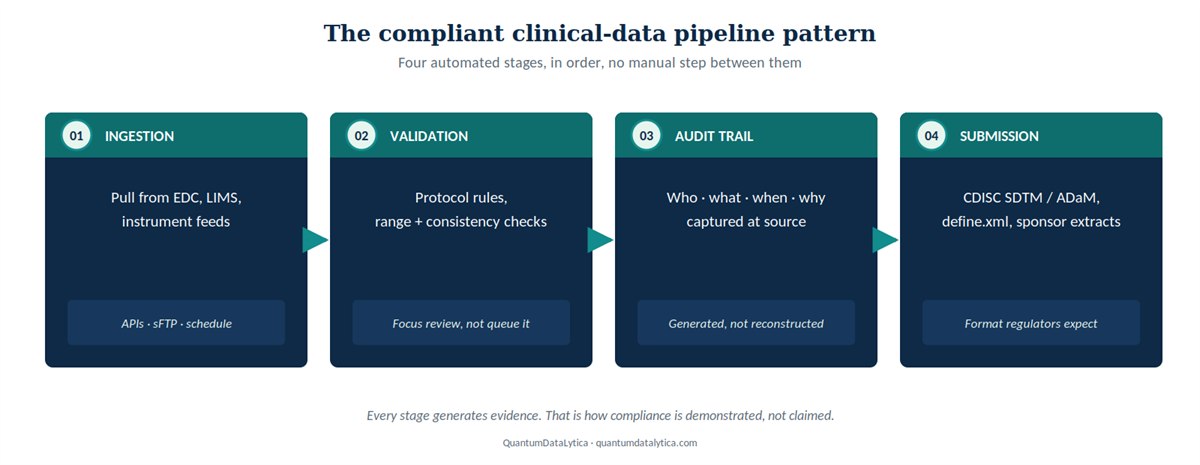
At the platform level, it’s four things running in sequence: pulling raw data in, checking it against protocol rules, logging every change with attribution, and packaging outputs the way regulators expect.
- 4 – stages in a compliant pipeline
- 0 – manual handoffs between stages
- 1 – audit trail, generated rather than reconstructed
Why Do Manual Clinical Data Workflows Break at Scale?
The failure mode isn’t speed. It’s traceability. When five people touch a dataset across two contract research organizations, three EDC systems, and a lab feed, the audit question – who changed this value, when, and why? – becomes unanswerable without automation.
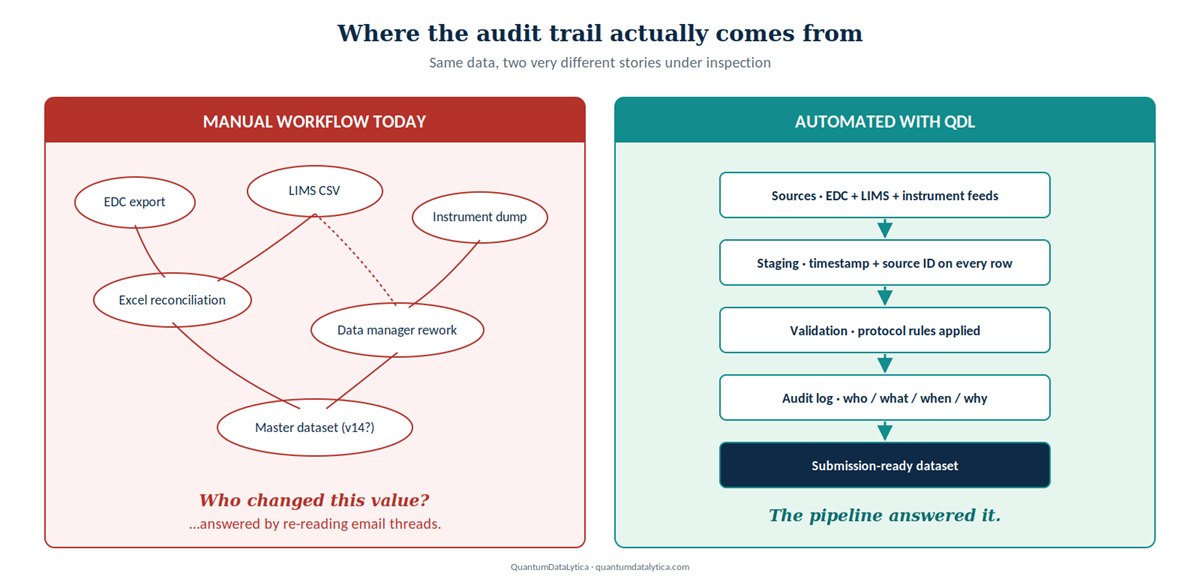
Manual workflows also concentrate risk in individual data managers. If the person who knows the reconciliation logic leaves mid-study, that knowledge leaves with them.
Where manual pipelines leak
- Version drift between EDC exports and the master analysis dataset
- Query cycles that stretch database lock by weeks
- Instrument data arriving in formats the study database wasn’t set up for
- Audit trails reconstructed after the fact – not captured in real time
Where automation earns its cost
- Every row carries a timestamp and a source ID from the moment it lands
- Validation runs on ingestion – reviewers see the 12 flagged rows, not 8,000
- Instrument outputs mapped once, reused every study
- Audit log written as the pipeline runs – nothing to reconstruct
What Does a Compliant Clinical-Data Pipeline Look Like End-to-End?
A compliant pipeline runs four stages on every dataset, in order, with no manual step between them. Referring back to Fig 1: ingestion → validation → audit → submission.
How does ingestion work from EDC, LIMS, and instrument sources?
Ingestion is where most legacy workflows leak time. Automated ingestion connects directly to the source – an EDC API, a LIMS export path, a scheduled sFTP drop from an instrument vendor – and pulls new records on a defined cadence.
The pipeline doesn’t wait for a human to run an export. It writes what it pulls to a staging layer with a timestamp and a source ID, so every downstream question about provenance has an answer.
Rule of thumb: if a data manager still has to run an export to kick off the next step, ingestion is not automated. It’s just faster copy-paste.
How do you validate clinical data and catch anomalies?
Validation is the second stage: apply protocol rules to every incoming record and route the failures somewhere a data manager can act on them. Range checks, missing-field rules, cross-form consistency checks, and – for IVD – instrument-calibration checks all run here.
The point isn’t to eliminate human review. It’s to focus it. A validation stage that surfaces the twelve records that need attention out of eight thousand is far more useful than a queue of eight thousand records that “look fine.”
What does an audit trail need to include?
An audit trail that will survive an inspection has four things on every change: who made it, what changed, when it changed, and why. The last one is the one manual workflows miss most often.
Automated pipelines can capture this at the source because they know what triggered every write – a source-system pull, a validation-rule flag, a data manager’s manual override with a reason code. The trail is generated, not reconstructed.
Watch for: an audit trail that only records the final state is not enough. Inspectors ask about the change history – who touched what and why – not just what the record looks like today.
How do you produce regulatory submission-ready outputs?
The final stage packages the cleaned, audited dataset in the format regulators or your sponsor expect – CDISC SDTM and ADaM datasets, a define.xml, submission-ready extracts for a specific regulatory pathway.
Automation matters here because submission format is the one place a manual reformat can introduce errors nobody catches until the review cycle.
How Does This Pattern Work for IVD Studies Specifically?
IVD trials generate a specific data profile that stresses manual workflows harder than standard clinical trials do. You’re combining patient-level clinical data with instrument-generated results – often high-volume, often from multiple analyzer models – and you need to reconcile them at the specimen level for a diagnostic accuracy analysis.
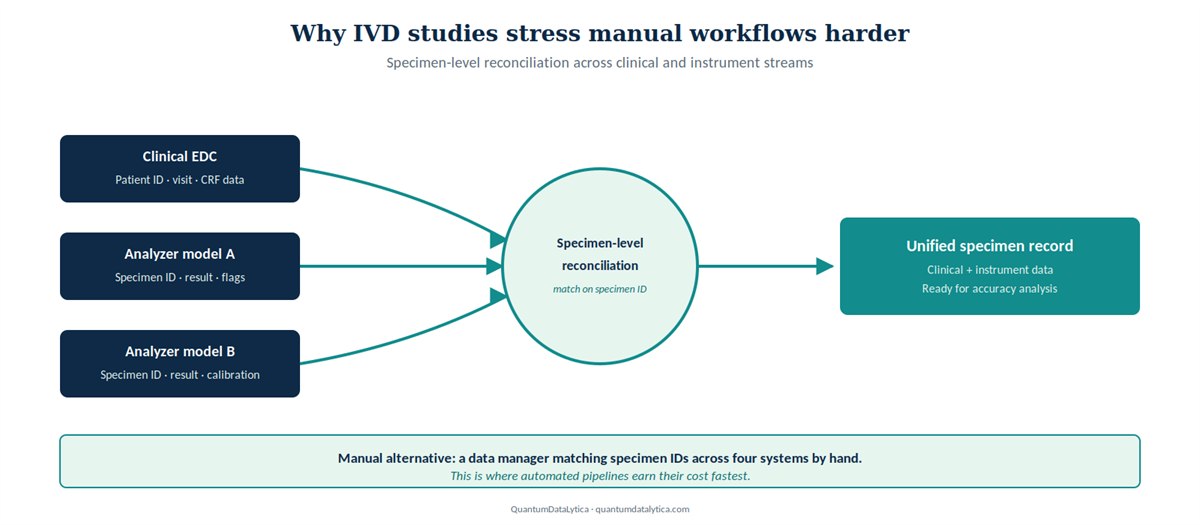
That reconciliation is where automated pipelines earn their cost, because the alternative is a data manager matching specimen IDs across four systems by hand.
A Real IVD Case: What Did QuantumDataLytica Automate?
QuantumDataLytica automated a clinical data pipeline for an IVD clinical trial workflow – connecting instrument and clinical data feeds, running validation at the specimen level, and preparing submission-ready outputs for the sponsor.
The pattern is repeatable. That’s why it’s captured as a Templates Hub workflow – WF-06: Compliant Clinical Data Pipeline – so a new study can launch a similar pipeline without a custom build.
What Compliance Frameworks Apply to Clinical Data Pipelines?
Three frameworks touch clinical trial data pipelines most often, and each applies to the pipeline itself – not only the storage systems at either end.
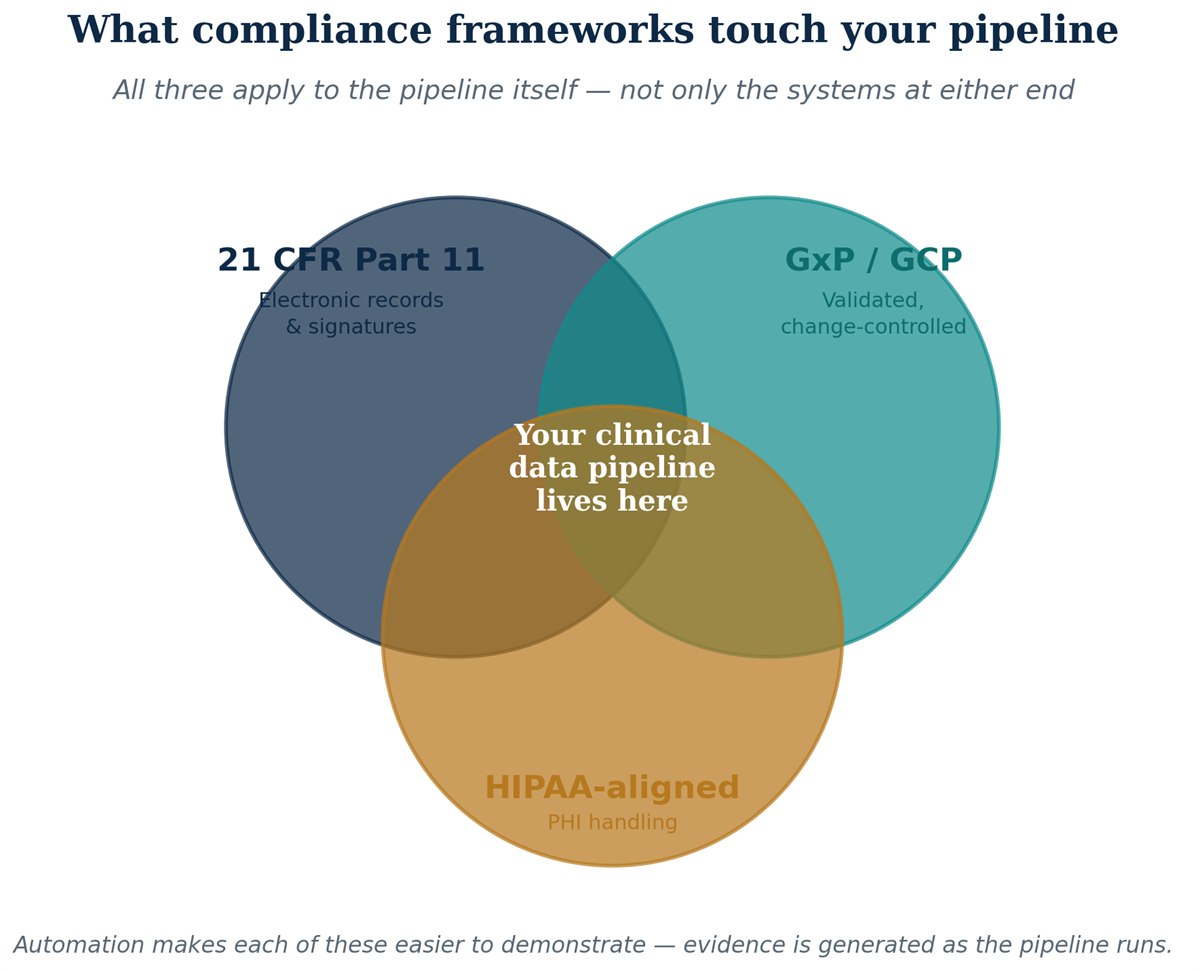
21 CFR Part 11 governs electronic records and signatures in FDA-regulated studies. The pipeline needs to preserve record integrity, capture attributable audit trails, and control access – the same requirements the source EDC has.
GxP (particularly GCP for clinical trials) requires that data-handling processes be documented, validated, and change-controlled. An automated pipeline is easier to validate than a manual workflow because the logic is inspectable and repeatable.
HIPAA-aligned data handling is required for any US clinical data that includes PHI. QuantumDataLytica is designed to support HIPAA-aligned workflows, with a BAA available on eligible plans.
Automation makes compliance easier to demonstrate, not harder – because the evidence is generated as the pipeline runs.
When Should You Use a Template vs. a Custom Pipeline?
Use a template (WF-06) when
- Study shape matches a common pattern
- EDC → master dataset with standard validation
- IVD instrument reconciliation at specimen level
- Defined submission output (CDISC SDTM / ADaM)
- You want to be moving data in days, not months
Build custom via the Developer Hub when
- Unusual data source or proprietary analysis workflow
- Integration to a system not covered by an existing template yet
- Python devs on the team who can build machines via the Quantum CLI
- Study team consumes the machines the same way they’d consume any template component
Most studies land in the middle: a template as the spine, one or two custom machines built through the Developer Hub for the specific system the study depends on.
How Do You Get Started with Clinical Trial Data Automation?
Start with the pipeline you already run – even if it’s mostly manual. Map the four stages against it: where does data come in, where is it validated, where is the audit trail captured, and how do submission outputs get built?
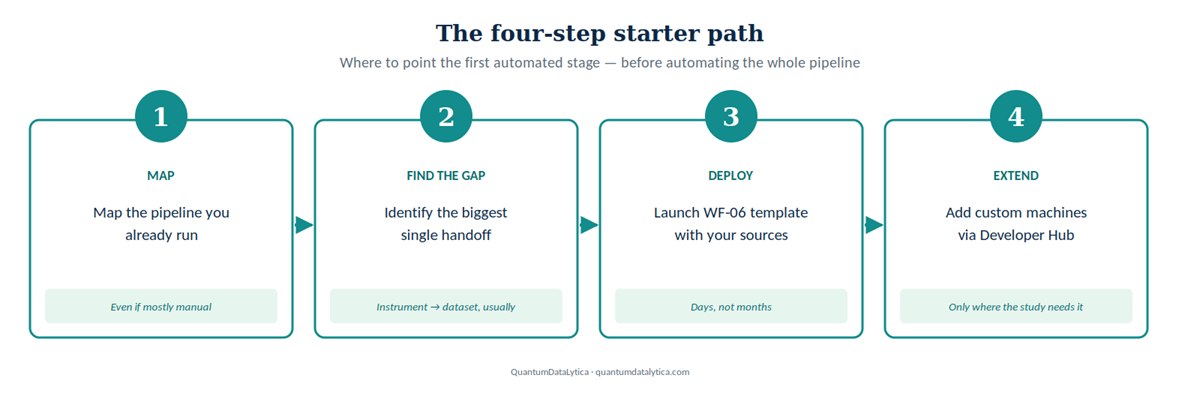
Most teams find the biggest gap is one specific handoff – instrument data to master dataset, or query-response back to source. That’s where the first automated stage earns the fastest return, and it’s a smaller commitment than automating the entire pipeline at once.
If the pipeline maps closely to the WF-06 pattern, the fastest path is to deploy the template with your source systems configured, then extend where the study needs it.
See the WF-06 Compliant Clinical Data Pipeline in Action
Bring your protocol, your source systems, and your submission target. We’ll walk through the pipeline pattern against your study.
Related Reading
Explore the IVD clinical trial data automation use case, browse the Templates Hub, or see how the same platform pattern automated a hotel switchboard workflow across 500+ properties.
FAQs
No. An EDC system captures data at the site. Clinical trial data automation is the pipeline that moves data out of the EDC, validates it against protocol rules, maintains an audit trail across systems, and produces submission-ready outputs.
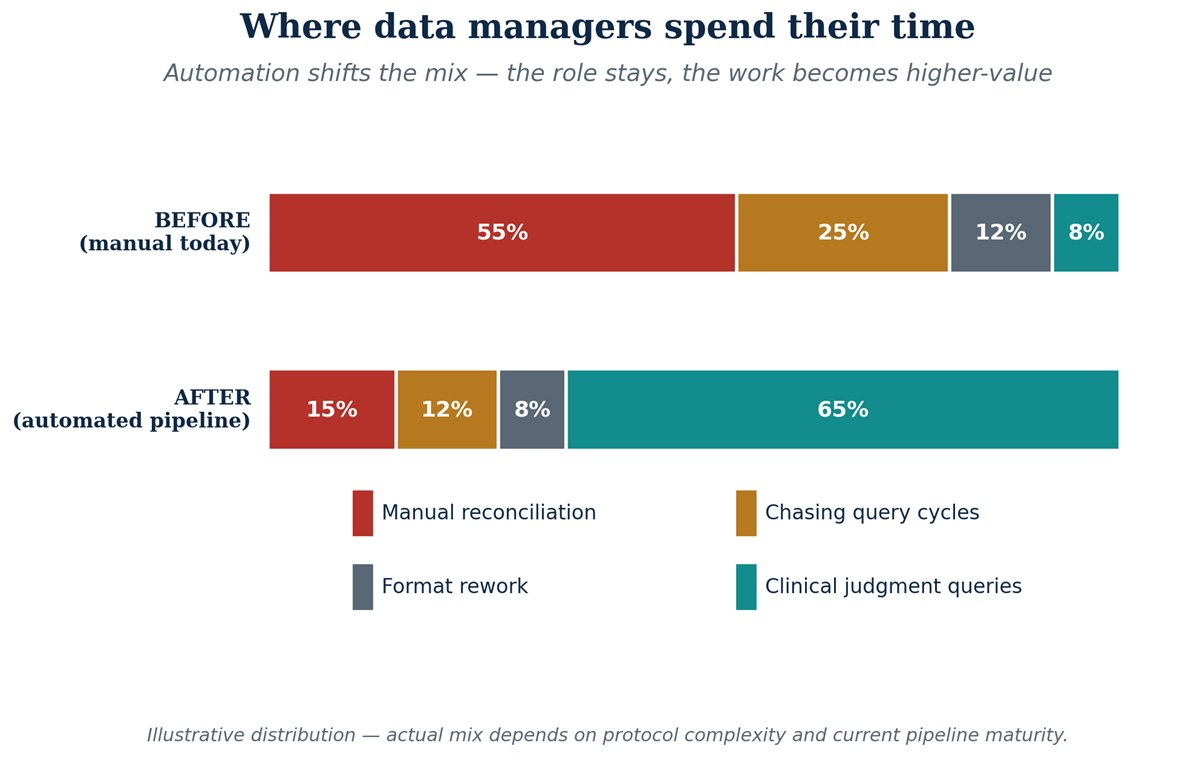
No - it shifts what they do. Data managers spend less time on manual reconciliation and export tasks, and more time on the queries that actually need clinical judgment. The role stays; the work becomes higher-value.
Automated pipelines are validated the same way any GxP system is: with a documented specification, executed test protocols, and change control. The advantage over a manual workflow is that the logic is inspectable, so validation evidence is easier to generate.
IVD trials add instrument-generated results that need to be reconciled with clinical data at the specimen level. This creates more sources, more format variation, and a specific need for specimen-level matching that stresses manual workflows quickly.
Yes. The ingestion stage treats each source as a connector, so a multi-site or multi-CRO study can bring several EDCs into the same validated pipeline.
CDISC SDTM and ADaM datasets, define.xml, and sponsor-specific extracts are common outputs. The submission stage is configurable to the format your regulatory pathway requires.
The platform is designed to support HIPAA-aligned data workflows, with a BAA available on eligible plans. Data handling architecture and storage location should be reviewed with QDL's team before deployment on a live study.
A template-based deployment (WF-06) can start moving data in days once source-system access and credentials are in place. A fully custom pipeline for a complex study takes longer - timeline depends on the number of sources, protocol complexity, and validation requirements.

Nitin Suvagiya is the Architect and Lead Developer of the Quantum-Core-Engine at Quantum Datalytica, driving advanced workflow automation and data analytics solutions. As a DevOps-certified engineer, he specializes in cloud automation, CI/CD pipelines, Kubernetes, and scalable infrastructure. His expertise in software architecture and machine development ensures seamless deployment, high-performance computing, and optimized workflows. Nitin plays a crucial role in building intelligent, data-driven solutions that empower businesses with efficiency, reliability, and innovation in Quantum Datalytica’s ecosystem.
Recent Blogs
-
Workflow Automation 29 Sep, 2026
Build Once, Run Everywhere: Reusable Data Pipelines with QuantumDataLytica
-
Data Management Innovations 22 Sep, 2026
No-Code ETL vs Traditional ETL: The Definitive 2026 Comparison
-
Workflow Automation 09 Sep, 2026
Clinical Trial & IVD Data Automation: Automating Compliant Pipelines End-to-End
-
Personalized Learning 03 Sep, 2026
From One Spreadsheet to Ten Study Plans
-
Workflow Automation 26 Aug, 2026
From HubSpot to Airtable to Inbox in Seconds: The No-Code Deal Sync Workflow, Explained